General information
Reprocessing thermoplastic return material (regrind, reground pellets, recyclate) generally fails due to uncertainty about the effect of recyclate additions on the quality of plastic products under practical conditions. This uncertainty is usually based less on factually justified objections than on prejudices that categorically brand waste addition as an unacceptable quality risk, as well as on a lack of experience.
By combining experiment and calculation, the permissible recyclate proportions for measurable quality criteria of plastic products are determined. This concept has been thoroughly verified experimentally for the most important plastics, processes, and quality requirements.
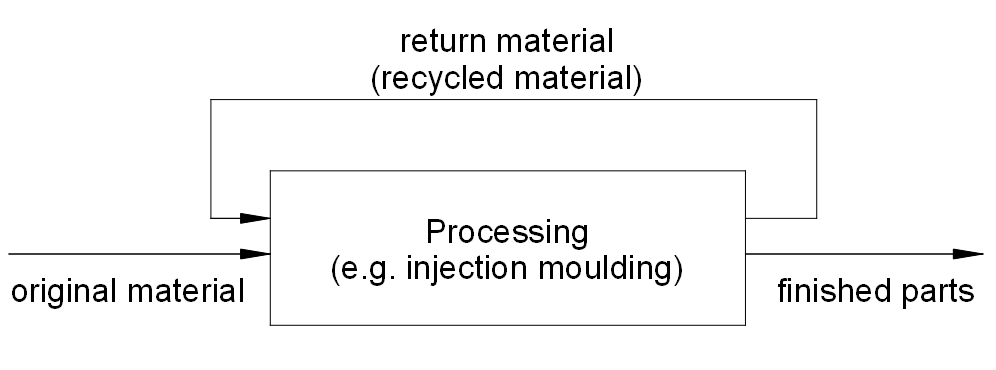
As an example, the shortest recycling route (closed material loops within the processing plant) is considered, which offers the greatest economic and ecological advantages. The well-known dependence of part properties on processing cycles leads to the determination of the limiting recyclate content. From a certain limiting recyclate content onward, the specified property limit value is no longer exceeded or undercut, even with any number of material passes. This limit is identical to the maximum permissible proportion of return material. Lower proportions are unproblematic for the utility value of the product.
If this limit value is determined through systematic testing, this involves considerable effort (tests, measurements, evaluations). Instead of using elaborate experiments, it makes sense to predict the property changes using a calculation model in order to determine the limiting recyclate content in this way.
For the addable recyclate proportion, which does not exist as a fixed material-related value, raw material manufacturers' company publications often cite a blanket figure of 20%. In reality, however, this percentage can often be significantly exceeded depending on the molded part. With regard to processing properties, the influence of the recyclate on feeding and flow behavior (molecular degradation/crosslinking reactions) must be taken into account. Usual deviations in processing parameters (time, temperature, pressure) can, however, mostly be neglected.
Processing cycle for determining permissible proportions of regenerated material: