| (ABS+PC) |
Blend of acrylonitrile-butadiene-styrene graft copolymer and polycarbonate according to DIN 16780, density 1.08...1.11 g/cm³. |
| (ABS+PC)-FR |
Blend of acrylonitrile-butadiene-styrene graft copolymer and polycarbonate according to DIN 16780 with fire protection finish. Density 1.12...1.14 g/cm³. |
| (ABS+PVC-U) |
Blends of acrylonitrile-butadiene-styrene graft copolymer and plasticizer-free polyvinyl chloride according to DIN 16780. 1.15 - 1.21 g/cm³ density. |
| (ASA+PC) |
Blends of acrylonitrile-styrene-acrylic ester graft copolymer and polycarbonate according to DIN 16780, density approx. 1.15 g/cm³. |
| (ASA+PC)-FR |
Blends of acrylonitrile-styrene-acrylic ester graft copolymer according to DIN 16780 with fire protection finish. Density approx. 1.25 g/cm³. |
| (CAB+EVA) |
Blends of cellulose acetobutyrate and ethylene-vinyl acetate copolymer. By varying the E/VA component (usually 5...25%), special types of different hardness are available. Density 1.15...1.22 g/cm³. |
| (CP+EVA) |
Blends of cellulose propionate and ethylene-vinyl acetate graft copolymer. By varying the E/VA component (usually 10...30%), special types of different hardness are available. Density 1.17...1.23 g/cm³. |
| (EPDM-X+PP) |
Blends of dynamically cross-linked EPDM with polypropylene. Thermoplastic polyolefin elastomers (TPO) very soft to hard adjustment of special grades depending on EPDM content. Density 0.89...0.98 g/cm³. |
| (EVAVC-X+PVDC) |
Blends of partially crosslinked ethylene-vinyl acetate-vinyl chloride cop. and polyvinylidene chloride. As the composition is not exactly known, the above information is only a rough orientation. Density 1.1...1.26 g/cm³. |
| (PBT+ASA) |
Blends of polybutylene terephthalate and acrylonitrile-styrene-acrylic ester graft copolymer. Density approx. 1.22 g/cm³. |
| (PBT+ASA)-GF10 |
Blends of polybutylene terephthalate and acrylonitrile-styrene-acrylic ester graft copolymer with approx. 10% glass fibres. Density 1.29...1.32 g/cm³. |
| (PBT+ASA)-GF20 |
Blends of polybutylene terephthalate and acrylonitrile-styrene-acrylic ester graft copolymer with approx. 20% glass fibres. Density 1.37...1.39 g/cm³. |
| (PBT+ASA)-GF30 |
Blends of polybutylene terephthalate and acrylonitrile-styrene-acrylic ester graft copolymer with approx. 30% glass fibres. Density 1.45...1.47 g/cm³. |
| (PBT+PC) |
Blends of polybutylene terephthalate and polycarbonate. Density 1.25...1.27 g/cm³. |
| (PBT+PET) |
Blends of polybutylene and polyethylene terephthalate. Density approx. 1.33 g/cm³. |
| (PBT+PET)-GF17±3 |
Blends of polybutylene and polyethylene terephthalate with 14...20% glass fibres. Density 1.41...1.47 g/cm³. |
| (PBT+PET)-GF30 |
Blends of polybutylene and polyethylene terephthalate with approx. 30% glass fibres. Density 1.53...1.56 g/cm³. |
| (PBT+PET)-GF45 |
Blends of polybutylene and polyethylene terephthalate with approx. 45% glass fibres. Density approx. 1.67 g/cm³. |
| (PBT+PET)-(GF+M)40 |
Blends of polybutylene terephthalate with approx. 40% glass-fibre mineral mixture. Density 1.62...1.66 g/cm³. |
| (PBT+PET)-TiO2 |
Blends of polybutylene and polyethylene terephthalate with approx. 25% titanium dioxide to achieve high reflection and light density. Density approx. 1.55 g/cm³. |
| (PBT+PET)-M40 |
Blends of polybutylene and polyethylene terephthalate with approx. 40% mineral. Density approx. 1.6 g/cm³. |
| (PBT+PET)-GF15-FR |
Blends of polybutylene and polyethylene terephthalate with approx. 15% glass fibres and fire protection equipment. Density 1.52...1.54 g/cm³. |
| (PBT+PET)-GF30-FR |
Blends of polybutylene and polyethylene terephthalate with approx. 30% glass fibres and fire protection equipment. Density approx. 1.66 g/cm³. |
| (PBT+PET)-HI |
Elastomer-modified blends of polybutylene and polyethylene terephthalate. Density approx. 1.2 g/cm³. |
| (PBT+PET)-HI-(GF+M)40 |
Elastomer-modified blends of polybutylene and polyethylene terephthalate with approx. 40% glass-fibre mineral mixture. Density approx. 1.6 g/cm³. |
| (PC+ABS) |
Blends of polycarbonate and acrylonitrile-butadiene-styrene graft copolymer. Density 1.12...1.16 g/cm³. |
| (PC+ABS)-GF13±3 |
Blends of polycarbonate and acrylonitrile-butadiene-styrene graft copolymer with approx. 10% glass fibres. Density 1.19...1.22 g/cm³. |
| (PC+ABS)-GF25±5 |
Blends of polycarbonate and acrylonitrile-butadiene-styrene graft copolymer with 20...30% glass fibres. Density 1.24...1.33 g/cm³. |
| (PC+ABS)-GF15±5-FR |
Blends of polycarbonate and acrylonitrile-butadiene-styrene graft copolymer with fire protection finish and 10...20% glass fibres. Density 1.29...1.34 g/cm³. |
| (PC+ABS)-FR |
Blends of polycarbonate and acrylonitrile-butadiene-styrene graft copolymer with fire protection finish. Density 1.14...1.20 g/cm³. |
| (PC+PBT) |
Blends of polycarbonate and polybutylene terephthalate. Density 1.21...1.24 g/cm³. |
| (PC+PBT)-GF10 |
Blends of polycarbonate and polybutylene terephthalate with approx. 10% glass fibres. Density approx. 1.3 g/cm³. |
| (PC+PBT)-GF30 |
Blends of polycarbonate and polybutylene terephthalate with approx. 30% glass fibres. Density 1.50...1.52 g/cm³. |
| (PC+PBT)-HI |
Elastomer-modified blends of polycarbonate and polybutylene terephthalate. Density 1.21...1.24 g/cm³. |
| (PC+PET) |
Blends of polycarbonate and polyethylene terephthalate. Density approx. 1.22 g/cm³. |
| (PC+PET)-GF30 |
Blends of polycarbonate and polyethylene terephthalate with approx. 30% glass fibres. Density approx. 1.51 g/cm³. |
| (PE-LD+PIB) |
Blend of PE-LD and 40...60% polyisobutylene. Density 0.91...0.92 g/cm³. |
| (PEEST+PBT) |
Blends of thermoplastic polyether ester elastomer and polybutylene terephthalate. Density 1.14...1.20 g/cm³. |
| (PEESTUR+ABS)-SH/D50 |
Blends of thermoplastic polyurethane elastomers (also: TPU) and ABS. Density 1.15...1.17 g/cm³. |
| (PEI+PC) |
Blends of polyetherimide copolymer and polycarbonate. Density 1.27...1.30 g/cm³. |
| (PF+NBR)-(WD+MD) |
Moulding material made of phenol-formaldehyde resin, rubber (e.g. NBR) and wood flour-mineral flour mixtures. Density 1.43...1.5 g/cm³. |
| (PF31+NBR) |
Moulding material made of phenol-formaldehyde resin (novolak), rubber (e.g. NBR) and wood flour. Density approx. 1.3 g/cm³. |
| (PP+EPDM) |
Blends of polypropylene and non-crosslinked olefin elastomers (e.g. EPDM) to DIN 16774 with elastomer contents of up to 50% including reactor blends. Density 0.89...0.92 g/cm³. |
| (PPE+PA12) |
Blends of polyphenylene ether and polyamide. Density approx. 1.03 g/cm³. |
| (PPE+PA66) |
Blends of polyphenylene ether and polyamide. Density 1.09...1.10 g/cm³. |
| (PPE+PA66)-GF10 |
Blends of polyphenylene ether and polyamide with approx. 10% glass fibres. Density approx. 1.16 g/cm³. |
| (PPE+PA66)-GF25±5 |
Blends of polyphenylene ether and polyamide with 20...30% glass fibres. Density 1.23...1.32 g/cm³. |
| (PPE+PA66)-M15±5 |
Blends of polyphenylene ether and polyamide with 10...20% minerals. Density 1.17...1.27 g/cm³. |
| (PPE+PA66)-CF25±5 |
Blends of polyphenylene ether and polyamide with 20...30% carbon fibres. Density 1.18...1.24 g/cm³. |
| (PPE+SB)-HDTA165±5 |
Modified polyphenylene ether with high heat resistance. Density approx. 1.06 g/cm³. |
| (PPE+SB)-HDTA175±5 |
Modified polyphenylene ether with high heat resistance. Density 1.04...1.06 g/cm³. |
| (PPE+SB) |
Blends of polyphenylene ether and styrene-butadiene polymers. Density 1.04...1.07 g/cm³. |
| (PPE+SB)-GF15±5 |
Blends of polyphenylene ether and styrene-butadiene polymers with approx. 20% glass fibres. Density 1.11...1.24 g/cm³. |
| (PPE+SB)-GF30 |
Blends of polyphenylene ether and styrene-butadiene polymers with approx. 30% glass fibres. Density 1.26...1.30 g/cm³. |
| (PPE+SB)-GF40 |
Blends of polyphenylene ether and styrene-butadiene polymers with approx. 40% glass fibres. Density approx. 1.38 g/cm³. |
| (PPE+SB)-CF35±5 |
Blends of polyphenylene ether and styrene-butadiene polymers with 30...40% carbon fibers. Density 1.21...1.27 g/cm³. |
| (PPE+SB)-AR-PTFE15 |
Blends of polyphenylene ether and styrene-butadiene polymers with approx. 15% PTFE additive. Density approx. 1.15 g/cm³. |
| (PPE+SB)-FR-HDTA175±5 |
Modified polyphenylene ether with high heat resistance and fire protection properties. Density approx. 1.04 g/cm³. |
| (PPE+SB)-FR-HDTA150 |
Modified polyphenylene ether with high heat resistance and fire protection properties. Density approx. 1.06 g/cm³. |
| (PPE+SB)-FR-V1,V0 |
Blends of polyphenylene ether and styrene-butadiene polymers with fire protection finish. Density 1.06...1.15 g/cm³. |
| (PPE+SB)-(GF+M)10-FR |
Blends of polyphenylene ether and styrene-butadiene polymers with approx. 10% glass-fibre mineral mixture and fire protection equipment. Density approx. 1.2 g/cm³. |
| (PPE+SB)-(GF+M)35±5-FR |
Blends of polyphenylene ether and styrene-butadiene polymers with 30...40% glass-fibre mineral mixture and fire protection finish. Density 1.35...1.45 g/cm³. |
| (PPE+SB)-GF15±5-FR |
Blends of polyphenylene ether and styrene-butadiene polymers with 10...20% glass fibres and fire protection finish. Density 1.15...1.3 g/cm³. |
| (PPE+SB)-GF30-FR |
Blends of polyphenylene ether and styrene-butadiene polymers with approx. 30% glass fibres and fire protection finish. Density 1.28...1.36 g/cm³. |
| (PPE+SB)-FR-V1,V0 |
Blends of polyphenylene ether and styrene-butadiene polymers with fire protection and antistatic finish. Density approx. 1.14 g/cm³. |
| (PPE+SB)-HI |
Highly impact resistant blends of polyphenylene ether and styrene-butadiene polymers. Density 1.04...1.06 g/cm³. |
| (PPE+SB)-HI-FR-V1,V0 |
Highly impact resistant blends of polyphenylene ether and styrene-butadiene-poly-merisates with fire protection finish. Density 1.06...1.10 g/cm³. |
| (PS+PE) |
Blend of polystyrene or impact-resistant polystyrene and low to high density polyethylene. Density 0.99...1.01 g/cm³. |
| (PSU+ABS) |
Blends of polysulfone and ABS. Density approx. 1.13 g/cm³. |
| (PVC-P+NBR) |
Plasticizer-containing polyvinyl chloride with nitrile rubber additive. Density 1.14...1.25 g/cm³. |
| (PVC+PE-C) |
Blend of polyvinyl chloride and chlorinated polyethylene, also known as PVC-HI. Impact resistance can be influenced in a wide range depending on the PE-C content. Also ger. Filler content (e.g. chalk). Density 1.35...1.45 g/cm³. |
| (SAN+NBR) |
Blend made of SAN and acrylonitrile butadiene rubber. Formerly known as ABS copolymer. Density 1.04...1.05 g/cm³. |
| (UP+MF)-WD |
Blends of unsaturated polyester resin and melamine-formaldehyde resin (IPN structure) with wood flour. Density approx. 1.6 g/cm³. |
| (UP+MF)-LF |
Blends of unsaturated polyester resin and melamine-formaldehyde resin (IPN structure) with cellulose fibres. Density approx. 1.65 g/cm³. |
| (UP+MF)-MD |
Blends of unsaturated polyester resin and melamine-formaldehyde resin (IPN structure) with mineral flours. Density approx. 1.8 g/cm³. |
| (UP+MF)-GF+MD |
Blends of unsaturated polyester resin and melamine-formaldehyde resin (IPN structure) with glass fibres and mineral flours. Density approx. 2 g/cm³. |
| (UP+MF)-LF+MD-FR |
Blends of unsaturated polyester resin and melamine-formaldehyde resin (IPN structure) with organ. Fibres and mineral flours as well as fire protection equipment. Density 1.65...1.75 g/cm³. |
| ABS |
Medium impact acrylonitrile-butadiene-styrene graft copolymer according to DIN 16772, density 1.03...1.07 g/cm³. |
| ABS-GF7 |
Acrylonitrile-butadiene-styrene graft copolymer with approx. 7% glass fibres. Density approx. 1.1 g/cm³. |
| ABS-GF15±5 |
Acrylonitrile-butadiene-styrene graft copolymer according to DIN 16772 with 10...20% glass fibres. Density 1.10...1.22 g/cm³. |
| ABS-GF30±5 |
Acrylonitrile-butadiene-styrene graft copolymer according to DIN 16772 with 25...35% glass fibres. Density 1.22...1.36 g/cm³. |
| ABS-GB15±5 |
Acrylonitrile-butadiene-styrene graft copolymer according to DIN 16772 with 10...20% glass microspheres. Density 1.10...1.22 g/cm³. |
| ABS-GF12±3+GB12±3 |
Acrylonitrile-butadiene-styrene graft copolymer according to DIN 16772 with 9...15% glass fibres and glass microspheres each. Density 1.16...1.27 g/cm³. |
| ABS-FR-V0 |
Acrylonitrile-butadiene-styrene graft copolymer according to DIN 16772 with fire protection finish. Density 1.16...1.26 g/cm³. |
| ABS-GF15±5-FR-V0 |
Acrylonitrile-butadiene-styrene graft copolymer according to DIN 16772 with 10...20% glass fibres and fire protection finish. Density 1.25...1.38 g/cm³. |
| ABS-GF30±5-FR |
Acrylonitrile-butadiene-styrene graft copolymer according to DIN 16772 with 25...35% glass fibres and fire protection finish. Density 1.30...1.45 g/cm³. |
| ABS-GB15±5-FR |
Acrylonitrile-butadiene-styrene graft copolymer according to DIN 16772 with 10...20% glass microspheres and fire protection finish. Density 1.20...1.34 g/cm³. |
| ABS-GC |
Acrylonitrile-butadiene-styrene graft copolymer according to DIN 16772 preferably for electroplating. Density 1.04...1.06 g/cm³. |
| ABS-HI |
High impact acrylonitrile-butadiene-styrene graft copolymer according to DIN 16772, density 1.03...1.07 g/cm³. |
| ABS-HI-GF15±5 |
High impact acrylonitrile-butadiene-styrene graft copolymer according to DIN 16772 with 10...20% glass fibres. Density 1.09...1.21 g/cm³. |
| ABSA |
Acrylonitrile-butadiene-styrene-acrylic ester graft copolymer according to DIN 16772, density 1.05...1.07 g/cm³. |
| AMMA |
Acrylonitrile-methylmethacrylate copolymer with approx. 70% acrylonitrile as semi-finished casting type with yellowish inherent colour. Density approx. 1.17 g/cm³. |
| ANMA |
Acrylonitrile methacrylate graft copolymer with approx. 70% acrylonitrile (barrier plastic). Density 1.15...1.17 g/cm³. |
| ASA |
Acrylonitrile-styrene-acrylic ester graft copolymer according to DIN 16777, density approx. 1.07 g/cm³. |
| BIP |
Biodegradable starch-based polymers. Density 1.28...1.40 g/cm³. |
| CA-P |
Containing plasticizers. Cellulose acetate with various Degree of acetylation (2,2...2,8-acetate) according to DIN 7742. Hardness possible. Density 1.26...1.32. |
| CAB-P |
Cellulose acetobutyrate containing plasticizer according to DIN 7742. 5...20% of the plasticizer content makes special grades of different hardness available. Density 1.16...1.22 g/cm³. |
| CN-P |
Cellulose dinitrate with approx. 25% camphor softener etc. (celluloid). Density approx. 1.38 g/cm³. |
| CP-P |
Plasticizer-containing cellulose propionate with low acetate content (alsoCAP). By varying the plasticizer content (usually 8...20%), special types are available in different sizes. hardness. Density 1.17...1.24 g/cm³. |
| CSF |
Formaldehyde-cured rennet casein. Density 1.3...1.4 g/cm³. |
| DF-WD |
Moulding material made of dicyandiamide formaldehyde resin and wood flour. Density 1.4...1.5 g/cm³. |
| EA |
Copolymer of ethylene and acrylic acid or acrylates. Density 0.92...0.94 g/cm³. |
| EC-P |
Ethyl cellulose containing plasticizers. Density 1.12...1.15 g/cm³. |
| ECB |
Ethylene copolymer bitumen blends as thermoplastic moulding materials. Density approx. 0.97 g/cm³. |
| ECO |
Copolymers of ethylene and cycloolefins (e.g. ethylidene norbornene, dicyclopentadiene). Density 1.02...1.04 g/cm³. |
| ECTFE |
Ethylene chlorotrifluoroethylene copolymer having the same molar monomer ratio. Density 1.68...1.70 g/cm³. |
| ECTFE-GF20±5 |
Ethylene chlorotrifluoroethylene copolymer with 15...25% glass fibers. Density 1.77...1.84 g/cm³. |
| ECTFE-AR-PTFE10 |
Ethylene-chlorotrifluoroethylene copolymer with approx. 10% PTFE. Density approx. 1.72 g/cm³. |
| EP-MD |
Moulding material made of epoxy resin and minerals with increased heat resistance. Density 1.9...2.0 g/cm³. |
| EP-MD-CTI600 |
Moulding material made of epoxy resin and mineral flours with high creep resistance. Density 1.85...1.95 g/cm³. |
| EP-(GF+MD) |
Moulding material made of epoxy resin, glass fibres and minerals. Particularly suitable as a low-pressure molding compound for coatings. Density 1.9...2.0 g/cm³. |
| EP-GF+MD-HDTA250±20 |
Moulding material made of epoxy resin, glass fibres and minerals with increased impact strength and heat resistance. Density approx. 2 g/cm³. |
| EP-GS+MD |
Moulding material made of epoxy resin, long glass fibres and minerals. Density 1.75...1.8 g/cm³. |
| EP-MD-FR |
Moulding material made of epoxy resin and minerals with fire protection finish. Density 1.95...2.0 g/cm³. |
| EP-GF+MD-FR-CTI600 |
Moulding material made of epoxy resin, glass fibres and minerals with fire protection finish and high tracking resistance. Density 1.9...2.0 g/cm³. |
| EP-GS+MD-FR |
Moulding material made of epoxy resin, long glass fibres and minerals with fire protection finish. Density 1.75...1.8 g/cm³. |
| EP-G |
Thermoset epoxy casting resin with medium to high heat distortion temperature. Types 1000; 1020; 1021 and 1022 according to DIN 16946, with or without fire protection equipment on request. Density 1.16...1.25 g/cm³. |
| EP-G-MD60±5 |
Thermoset epoxy casting resin of medium to high heat distortion temperature with 55...65% mineral. Types 1000; 1021 and 1022 according to DIN 16946, with and without fire protection equipment on request. Density 1.7...1.9 g/cm³. |
| EP-G-Al(OH)3 |
Epoxy casting resin with approx. 60 % aluminium trihydrate as smoke-reducing fire protection finish. Density approx. 1.7 g/cm³. |
| EP-G-RV |
Cold-cured epoxy casting resin with low heat resistance. Types 1040; 1041 and 1042 according to DIN 16946, with and without fire protection equipment on request. Formally flexible to hard. Density 1.16...1.25 g/cm³. |
| EP-G-RV-MD55±5 |
Cold-cured epoxy casting resin with 50...60 % mineral filler. Type 1042 according to DIN 16946, with or without fire protection equipment on request. Density 1.55...1.75 g/cm³. |
| ETFE |
Ethylene tetrafluoroethylene copolymer with approx. 25% ethylene content. Density 1.67...1.75 g/cm³. |
| ETFE-GF12±3 |
Ethylene tetrafluoroethylene copolymer with 10...15% glass fibers. Density 1.75...1.79 g/cm³. |
| ETFE-GF25±5 |
Ethylene tetrafluoroethylene copolymer with 20...30% glass fibers. Density 1.82...1.89 g/cm³. |
| ETFE-CF15 |
Ethylene tetrafluoroethylene copolymer with approx. 15% carbon fibres. Density approx. 1.71 g/cm³. |
| ETFE-CF25±5 |
Ethylene tetrafluoroethylene copolymer with 20...30% carbon fibers. Density 1.72...1.74 g/cm³. |
| ETFE-AR-MoS2,CG |
Ethylene tetrafluoroethylene copolymer with additives of molybdenum disulphide and/or graphite up to 10%. Density 1.72...1.74 g/cm³. |
| ETFE-AR-GF25+PTFE15 |
Ethylene tetrafluoroethylene copolymer with approx. 25% glass fibres and approx. 15% PTFE. Density approx. 1.91 g/cm³. |
| ETFE-AR-M30+PTFE5 |
Ethylene tetrafluoroethylene copolymer with approx. 30% mineral and 5% PTFE. Density approx. 1.94 g/cm³. |
| ETFE-Z |
Ethylene-tetrafluoroethylene copolymer with antistatic finish. Density approx. 1.74 g/cm³. |
| EVA-D0,93 |
Ethylene-vinyl acetate copolymer according to DIN 16778 with 3...10% vinyl acetate. Density 0.925...0.935 g/cm³. |
| EVA-D0,95 |
Ethylene-vinyl acetate copolymer according to DIN 16778 with 15...30% vinyl acetate. Density 0.935...0.955 g/cm³. |
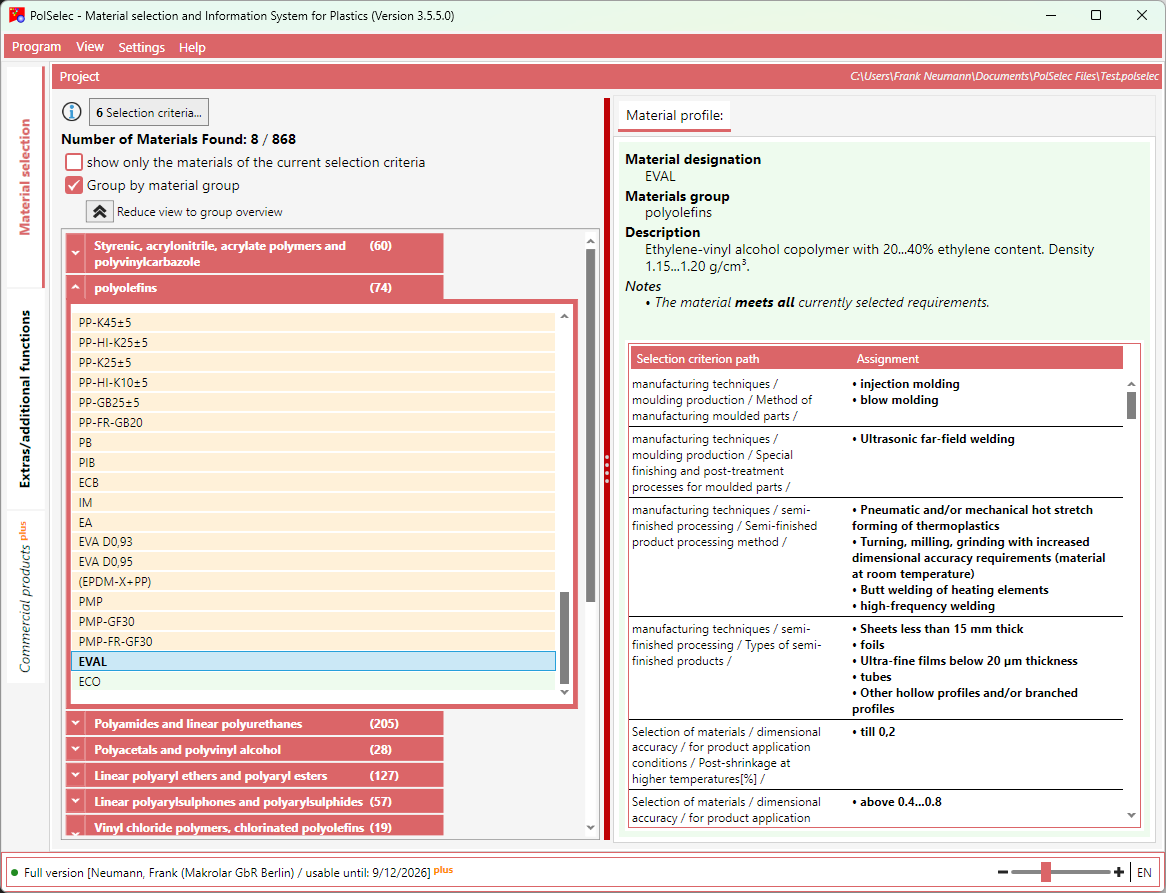
| EVAL |
Ethylene-vinyl alcohol copolymer with 20...40% ethylene content. Density 1.15...1.20 g/cm³. |
| FEP |
Tetrafluoroethylene-hexafluoropropylene copolymer (polyperfluoroethylene propylene). Density 2.12...2.18 g/cm³. |
| FEP-GF20 |
Polyperfluoroethylene propylene with approx. 20% glass fibres. Density approx. 2.2 g/cm³. |
| FEP-GG17±3 |
Polyperfluoroethylene propylene with 15...20% glass fibre material. Density approx. 2.2 g/cm³. |
| FEP-AR-PTFE10 |
Polyperfluoroethylene propylene with approx. 10% PTFE. Density approx. 2.15 g/cm³. |
| Hgw2072 |
Hard fabric coating compacted from phenolic resin and glass filament fabric according to DIN 7735. Density 1.6...1.8 g/cm³. |
| Hgw2081 |
Pressed hard fabric coating according to DIN 7735 made of phenolic resin and cotton coarse fabric or comparable synthetic fabric. Density 1.3...1.4 g/cm³. |
| Hgw2082 |
Pressed hard fabric coating according to DIN 7735 made of phenolic resin and cotton fine fabric or comparable synthetic fabric including special types. Density 1.3...1.4 g/cm³. |
| Hgw2083 |
Pressed hard fabric coating according to DIN 7735 made of phenolic resin and cotton fine fabric or comparable synthetic fabric including special types. Density 1.3...1.45 g/cm³. |
| Hgw2272 |
Pressed hard fabric coating according to DIN 7735 made of melamine resin and glass filament fabric. Density 1.8...2.0 g/cm³. |
| Hgw2282 |
Pressed hard fabric coating according to DIN 7735 made of melamine resin and cotton fine fabric including special types. Density 1.4...1.5 g/cm³. |
| Hgw2370 |
Hard fabric coating compacted from epoxy resin and glass filament fabric according to DIN 7735. Density 1.7...1.9 g/cm³. Observe stress corrosion cracking in the presence of mineral acids! |
| Hgw2372 |
Pressed hard fabric coating according to DIN 7735 made of epoxy resin and glass filament fabric including special types as well as fire protection equipment. Density 1.7...1.9 g/cm³. Note stress corrosion cracking caused by mineral acids! |
| Hgw2572 |
Hard woven laminate according to DIN 7735 made of silicone resin and glass filament fabric. Density 1.6...1.7 g/cm³. |
| Hm2471 |
Hard mat laminate according to DIN 7735 made of unsaturated polyester resin and glass mats. Density 1.4...1.6 g/cm³. |
| Hm2472 |
Hard mat laminate according to DIN 7735 made of unsaturated polyester resin and glass mats. Density 1.6...1.8 g/cm³. |
| Hp2061 |
Hard paper laminate according to DIN 7735 made of phenolic resin and cellulose paper including special grades. Density 1.3...1.4 g/cm³. |
| Hp2062 |
Hard paper laminates according to DIN 7735 made of phenolic resin and cellulose paper including special grades. Density 1.3...1.4 g/cm³. |
| Hp2063 |
Hard paper laminate according to DIN 7735 made of phenolic resin and cellulose paper. Density 1.3...1.4 g/cm³. |
| Hp2064 |
Hard paper laminate according to DIN 7735 made of phenolic resin and cellulose paper. Density 1.3...1.4 g/cm³. |
| Hp2262 |
Hard paper laminate according to DIN 7735 made of melamine resin and cellulose paper. Density 1.3...1.4 g/cm³. |
| Hp2361 |
Hard paper laminate according to DIN 7735 made of epoxy resin and cellulose paper including special grades. Density 1.3...1.4 g/cm³. |
| HPL-A |
Decorative hard paper laminates n. DIN 16929 in standard (type N), postforming (type P) and fire protection quality (type F). One or two-sided decorative layer of melamine resin and phenolic resin core. Density approx. 1.4 g/cm³. |
| IM |
Ethylene-acrylic acid copolymer crosslinked by Na or Zn ions (ionomers). Density 0.935...0.965 g/cm³. |
| KW-G |
Hydrocarbon casting resins made of highly crosslinked butadiene-styrene copolymer (approx. 80% butadiene) or dicyclopentadiene. Density 0.9...1 g/cm³.Heat deflection temperature depends on crosslinking conditions, filler addition usual. |
| LCP(HX2000) |
Liquid crystalline aryl copolyesters (amorphous solid state). Density approx. 1.27 g/cm³. Extreme anisotropy due to flow orientation (fiber structure). |
| LCP(HX2000)-GF30 |
Liquid crystalline aryl copolyesters (amorphous solid state) with approx. 30% glass fibres. Density approx. 1.49 g/cm³. |
| LCP(HX2000)-M30 |
Liquid crystalline aryl copolyester (amorphous solid state) with approx. 30% mineral. Density approx. 1.5 g/cm³. |
| LCP(HX4000) |
Liquid crystalline aryl copolyesters (semi-crystalline solid state). Density 1.29...1.32 g/cm³. Extreme anisotropy due to flow orientation (fiber structure). |
| LCP(HX4000)-GF30 |
Liquid crystalline aryl copolyesters (semi-crystalline solid state) with approx. 30% glass fibres. Density 1.51...1.53 g/cm³. |
| LCP(HX4000)-GF50 |
Liquid crystalline aryl copolyesters (semi-crystalline solid state) with approx. 50% glass fibres. Density approx. 1.71 g/cm³. |
| LCP(Ultrax amorph) |
Liquid crystalline aryl copolyesters (amorphous solid state). Density approx. 1.39 g/cm³. Extreme anisotropy due to flow orientation (fiber structure). |
| LCP(Ultrax amorph)-GF30 |
Liquid crystalline aryl copolyesters (amorphous solid state) with approx. 30% glass fibres. Density approx. 1.62 g/cm³. |
| LCP(Ultrax amorph)-M30 |
Liquid crystalline aryl copolyester (amorphous solid state) with approx. 30% mineral. Density approx. 1.63 g/cm³. |
| LCP(Ultrax amorph)-CF30 |
Liquid crystalline aryl copolyesters (amorphous solid state) with approx. 30% carbon fibres. Density approx. 1.47 g/cm³. |
| LCP(Ultrax krist) |
Liquid crystalline aryl copolyesters (semi-crystalline solid state). Density 1.39...1.40 g/cm³. Melting temperature approx. 315°C. Extreme anisotropy due to flow orientation (fiber structure). |
| LCP(Ultrax krist)-GF30 |
Liquid crystalline aryl copolyesters (semi-crystalline solid state) with approx. 30% glass fibres. Density approx. 1.62 g/cm³. |
| LCP(Ultrax krist)-M30 |
Liquid crystalline aryl copolyester (semi-crystalline solid state) with approx. 30% mineral. Density approx. 1.63 g/cm³. |
| LCP(Ultrax krist)-CF30 |
Liquid crystalline aryl copolyesters (semi-crystalline solid state) with approx. 30% carbon fibres. Density approx. 1.47 g/cm³. |
| LCP(Vectra A) |
Liquid crystalline aryl copolyesters (semi-crystalline solid state). Density approx. 1.40 g/cm³. Melting temperature approx. 280°C.Extreme anisotropy due to flow orientation (fibre structure). |
| LCP(Vectra A)-GF15 |
Liquid crystalline aryl copolyester with approx. 15% glass fibres. Density approx. 1.50 g/cm³. |
| LCP(Vectra A)-GF40±10 |
Liquid crystalline aryl copolyesters with 30...50% glass fibres. Density 1.60...1.80 g/cm³. |
| LCP(Vectra A)-(GF+M)50 |
Liquid crystalline aryl copolyester with approx. 50% glass fibre mineral mixture. Density approx. 1.80 g/cm³. |
| LCP(Vectra A)-M15 |
Liquid crystalline aryl copolyester with approx. 15% mineral. Density approx. 1.50 g/cm³. |
| LCP(Vectra A)-M35±5 |
Liquid crystalline aryl copolyester with 30...40% mineral. Density 1.65...1.70 g/cm³. |
| LCP(Vectra A)-MF30 |
Liquid crystalline aryl copolyesters with approx. 30% synthetic mineral fibres. Density approx. 1.70 g/cm³. |
| LCP(Vectra A)-CF30 |
Liquid crystalline aryl copolyesters with approx. 30% carbon fibres. Density approx. 1.50 g/cm³. |
| LCP(Vectra A)-AR-(GF+PTFE)35 |
Liquid crystalline aryl copolyester with approx. 35% glass-fibre PTFE mixture. Density approx. 1.62 g/cm³. |
| LCP(Vectra A)-AR-GF40+CG |
Liquid crystalline aryl copolyester with approx. 40% glass fibres and graphite additive. Density approx. 1.70 g/cm³. |
| LCP(Vectra A)-AR-(GF+M)55+CG |
Liquid crystalline aryl copolyester with approx. 55% glass-fibre mineral mixture and graphite additive. Density approx. 1.90 g/cm³. |
| LCP(Vectra A)-AR-PTFE25 |
Liquid crystalline aryl copolyester with approx. 25% PTFE. Density 1.50...1.54 g/cm³. |
| LCP(Vectra A)-CR-CG25 |
Liquid crystalline aryl copolyester with approx. 25% graphite. Particularly resistant to chemicals and hydrolysis. Density approx. 1.5 g/cm³. |
| LCP(Vectra A)-Z-GF30+CB4 |
Liquid crystalline aryl copolyesters with 30% glass fibres and 4% conductive carbon black as antistatic finish. Density approx. 1.61 g/cm³. |
| LCP(Vectra B) |
Liquid crystalline aryl copolyesteramide (partially crystalline solid state). Density approx. 1.4 g/cm³. Melting temperature approx. 280°C.Extreme anisotropy due to flow orientation (fibre structure). |
| LCP(Vectra B)-GF40±10 |
Liquid crystalline aryl copolyesteramide with 30...50% glass fibres. Density 1.60...1.80 g/cm³. |
| LCP(Vectra B)-CF30 |
Liquid crystalline aryl copolyesteramide with approx. 30% carbon fibres. Density approx. 1.50 g/cm³. |
| LCP(Vectra C) |
Liquid crystalline aryl copolyesters (semi-crystalline solid state). Density approx. 1.40 g/cm³. Melting temperature approx. 320 °C. Extreme anisotropy due to flow orientation (fibre structure). |
| LCP(Vectra C)-GF15 |
Liquid crystalline aryl copolyester with approx. 15% glass fibres. Density approx. 1.50 g/cm³. |
| LCP(Vectra C)-GF40±10 |
Liquid crystalline aryl copolyesters with 30...50% glass fibres. Density 1.60...1.80 g/cm³. |
| LCP(Vectra C)-(GF+TiO2)50 |
Liquid crystalline aryl copolyesters with approx. 20% glass fibres and approx. 30% titanium white. Special type to achieve high reflection and light density. Density approx. 1.96 g/cm³. |
| LCP(Vectra C)-M50 |
Liquid crystalline aryl copolyester with approx. 50% mineral. Density approx. 1.8 g/cm³. |
| LCP(Vectra C)-GC-M49±1 |
Liquid crystalline aryl copolyesters with approx. 50% special mineral to improve electrochemical electroplating properties. Density 1.85...1.93 g/cm³. |
| LCP(Vectra E) |
Liquid crystalline aryl copolyesters (semi-crystalline solid state). Density approx. 1.4 g/cm³. Melting temperature approx. 355°C.Extreme anisotropy due to flow orientation (fibre structure). |
| LCP(Vectra E)-GF30 |
Liquid crystalline aryl copolyesters with approx. 30% glass fibres. Density approx. 1.61 g/cm³. |
| LCP(Xydar)-GF37±8 |
Liquid crystalline aryl copolyesters (partially crystalline solid state) with 30...45% glass fibres. Density 1.60...1.76 g/cm³. |
| LCP(Xydar)-M50 |
Liquid crystalline aryl copolyester (partially crystalline solid state) with approx. 50% mineral. Density approx. 1.84 g/cm³. |
| LCP(Xydar)-(GF+M)50 |
Liquid crystalline aryl copolyester (partially crystalline solid state) with approx. 50% glass fibre mineral mixture. Density 1.78...1.79 g/cm³. |
| LPUR |
Linear, thermoplastic polyurethanes from hexamethylene diisocyanate and aliphatic dialcohols. Special types of different softness and impact strength by variation of the dialcohol comp... Density 1.19...1.21 g/cm³. |
| MABS |
Transparent methyl methacrylate-acrylonitrile-butadiene-styrene graft copolymer. Density 1.07...1.08 g/cm³. |
| MBS |
Methyl methacrylate-butadiene-styrene graft copolymer. Density 1.12...1.16 g/cm³. |
| MBS-HI |
High impact methyl methacrylate-butadiene-styrene graft copolymer. Density 1.08...1.12 g/cm³. |
| MF-(LF+MD) |
Moulding material made of melamine-formaldehyde resin and cellulose fibre-mineral flour mixtures. Density 1.5...1.75 g/cm³. |
| MF-GF |
Moulding material made of melamine-formaldehyde resin and glass fibres. Density 1.9...2.0 g/cm³. |
| MF-(GF+MD) |
Moulding material made of melamine-formaldehyde resin and glass-fibre mineral flour mixtures. Density 1.75...1.9 g/cm³. |
| MF150 |
Moulding material according to DIN 7708 made of melamine-formaldehyde resin and wood flour. Density 1.4...1.5 g/cm³. |
| MF152 |
Moulding material according to DIN 7708 made of melamine-formaldehyde resin and cellulose fibres. Also classified are moulding materials with a low mineral flour content that do not exactly correspond to MF152. Density 1.45...1.6 g/cm³. |
| MF152·7 |
Moulding material according to DIN 7708 made of melamine-formaldehyde resin and cellulose fibres. Approved for the production of food and drinking utensils. Density 1.45...1.6 g/cm³. |
| MF153 |
Moulding material according to DIN 7708 made of melamine-formaldehyde resin and cotton fibres and/or other organic textile fibres. Density 1.45...1.6 g/cm³. |
| MF154 |
Moulding material according to DIN 7708 made of melamine-formaldehyde resin and cotton fabric chips and/or other organic textile chips. Density 1.45...1.55 g/cm³. |
| MF155 |
Moulding material according to DIN 7708 made of melamine-formaldehyde resin and rock flour. Density 1.9...2.3 g/cm³. |
| MF156 |
Moulding material according to DIN 7708 made of melamine-formaldehyde resin and asbestos fibres. Density 1.75...1.95 g/cm³. |
| MF157 |
Moulding material according to DIN 7708 made of melamine-formaldehyde resin and asbestos fibre-wood flour mixture. Density 1.55...1.75 g/cm³. |
| MF158 |
Moulding material according to DIN 7708 made of melamine-formaldehyde resin and long-fibre asbestos. Density 1.8...2.0 g/cm³. |
| MMAS |
Methyl methacrylate-styrene copolymer. Density approx. 1.13 g/cm³. |
| MPF180 |
Moulding material according to DIN 7708 made of melamine-phenol-formaldehyde resin and wood flour. Density 1.45...1.6 g/cm³. |
| MPF181 |
Moulding material according to DIN 7708 made of melamine-phenol-formaldehyde resin and cellulose fibres. Density 1.5...1.7 g/cm³. |
| MPF181·5 |
Moulding material according to DIN 7708 made of melamine-phenol-formaldehyde resin and cellulose fibres. Electrically higher quality than MPF181. density 1.5...1.7 g/cm³. |
| MPF182 |
Moulding material according to DIN 7708 made of melamine-phenol-formaldehyde resin and wood flour-rock flour mixtures. Density 1.6...1.7 g/cm³. |
| MPF183 |
Moulding material according to DIN 7708 made of melamine-phenol-formaldehyde resin and cellulose fibre rock flour mixtures. Density 1.5...1.7 g/cm³. |
| PA11 |
Poly-11-aminoundecanamide according to DIN 16773. density 1.01...1.05 g/cm³. |
| PA11-GF30 |
Poly-11-aminoundecanamide according to DIN 16773 with approx. 30% glass fibres. Density 1.24...1.26 g/cm³. |
| PA11-GB30 |
Poly-11-aminoundecanamide according to DIN 16773 with approx. 30% glass microspheres. Density approx. 1.24 g/cm³. |
| PA11-AR-MoS2,CG |
Poly-11-aminoundecanamide with molybdenum disulphide or graphite additives. Density 1.04...1.09 g/cm³. |
| PA11-AR-GF25+CG |
Poly-11-aminoundecanamide with approx. 25% glass fibres and graphite additive. Density 1.22...1.31 g/cm³. |
| PA11-AR-GF45+CG |
Poly-11-aminoundecanamide with approx. 45% glass fibres and graphite additive. Density 1.42...1.44 g/cm³. |
| PA11-AR-BZ85±5+MoS2 |
Poly-11-aminoundecanamide with 80...90% bronze microspheres and molybdenum disulphide additive. Density 3.8...4.2 g/cm³. |
| PA11-GF30-FR |
Poly-11-aminoundecanamide with approx. 30% glass fibres and fire protection equipment. Density approx. 1.27 g/cm³. |
| PA11-P |
Poly-11-aminoundecanamide with plasticizer. Density 1.03...1.06 g/cm³. |
| PA12 |
Polylaurine lactam according to DIN 16773. density 1.01...1.03 g/cm³. |
| PA12-GF15 |
Polylaurin lactam according to DIN 16773 with approx. 15% glass fibre. Density 1.08...1.13 g/cm³. |
| PA12-GF25 |
Polylaurin lactam with approx. 25% glass fibres. Density approx. 1.17 g/cm³. |
| PA12-GF30 |
Polylaurin lactam according to DIN 16773 with approx. 30% glass fibres. Density 1.22...1.24 g/cm³. |
| PA12-GG30 |
Polylaurin lactam with approx. 30% glass fibre material. Density 1.23...1.26 g/cm³. |
| PA12-GF45±5 |
Polylaurine lactam according to DIN 16773 with 40...50% glass fibres. Density 1.33...1.45 g/cm³. |
| PA12-GB30 |
Polylaurin lactam according to DIN 16773 with approx. 30% glass microspheres. Density 1.22...1.26 g/cm³. |
| PA12-GB50 |
Polylaurin lactam according to DIN 16773 with approx. 50% glass microspheres. Density 1.44...1.46 g/cm³. |
| PA12-CF15 |
Polylaurin lactam with approx. 15% carbon fibres. Density approx. 1.08 g/cm³. |
| PA12-CF25±5 |
Polylaurine lactam with 20...30% carbon fibres. Density 1.10...1.16 g/cm³. |
| PA12-BaFe magnet |
Magnetizable polylaurine lactam highly filled with barium ferrite. Density 2.35...3.35 g/cm³. |
| PA12-AR-MoS2,CG |
Polylaurin lactam with minor additives of molybdenum disulphide or graphite. Density 1.02...1.06 g/cm³. |
| PA12-AR-PTFE20 |
Polylaurine lactam with approx. 20% PTFE. Density approx. 1.14 g/cm³. |
| PA12-AR-CG25 |
Polylaurin lactam with approx. 25% graphite additive. Density approx. 1.16 g/cm³. |
| PA12-AR-GF25+CG |
Polylaurin lactam with approx. 25% glass fibres and graphite additive. Density 1.20...1.22 g/cm³. |
| PA12-AR-GF30+PTFE15 |
Polylaurin lactam with approx. 30% glass fibres and 15% PTFE. Density 1.37...1.38 g/cm³. |
| PA12-AR-GF45+CG |
Polylaurin lactam with approx. 45% glass fibres and graphite additive. Density 1.39...1.41 g/cm³. |
| PA12-FR |
Polylaurine lactam according to DIN 16773 with fire protection equipment. Density 1.05...1.08 g/cm³. |
| PA12-G |
High molecular weight cast polyamide from laurinlactam. Density 1.03...1.04 g/cm³. |
| PA12-P |
Polylaurin lactam with various plasticizer additives, possibly also impact modified. Density 0.95...1.04 g/cm³. |
| PA12-P-Y-CB |
Plasticizer-containing polylaurine lactam with conductivity carbon black additive. Density 1.16...1.18 g/cm³. |
| PA12-P-Z |
Plasticizer-containing polylaurine lactam with antistatic finish. Density 1.07...1.12 g/cm³. |
| PA12-Y |
Electrically conductive polylaurine lactam with high heat resistance and stiffness. Density approx. 1.16 g/cm³. |
| PA12-Y-CB |
Polylaurin lactam with special conductive carbon black additive. Density 1.10...1.16 g/cm³. |
| PA12-Z-CB |
Polylaurin lactam with antistatic finish by addition of carbon black. Density 1.06...1.10 g/cm³. |
| PA12-Z-GF30+CB |
Polylaurin lactam with approx. 30% glass fibres and antistatic treatment with carbon black additive. Density 1.27...1.28 g/cm³. |
| PA46 |
Polytetramethylene adipamide. Density approx. 1.18 g/cm³. |
| PA46-GF30 |
Polytetramethylene adipamide with approx. 30% glass fibres. Density 1.40...1.42 g/cm³. |
| PA46-M40 |
Polytetramethylene adipamide with approx. 40% mineral. Density 1.50...1.52 g/cm³. |
| PA46-FR |
Polytetramethylene adipamide with fire protection equipment. Density approx. 1.38 g/cm³. |
| PA46-GF30-FR |
Polytetramethylene adipamide with approx. 30% glass fibres and fire protection equipment. Density approx. 1.68 g/cm³. |
| PA6 |
Polycaprolactam according to DIN 16773. density 1.12...1.14 g/cm³. |
| PA6-GF15±5 |
Polycaprolactam according to DIN 16773 with 10...20% glass fibres. Density 1.21...1.29 g/cm³. |
| PA6-GF30±5 |
Polycaprolactam according to DIN 16773 with 25...35% glass fibres. Density 1.30...1.40 g/cm³. |
| PA6-GF45±5 |
Polycaprolactam with 40...50% glass fibres. Density 1.45...1.58 g/cm³. |
| PA6-GF60 |
Polycaprolactam according to DIN 16773 with approx. 60% glass fibres. Density approx. 1.7 g/cm³. |
| PA6-(GF+GB)35±5 |
Polycaprolactam with 30...40% glass-fibre glass microsphere mixture. Density 1.34...1.44 g/cm³. |
| PA6-(GF+M)35±5 |
Polycaprolactam with 30...40% glass-fibre mineral mixture. Density 1.36...1.52 g/cm³. |
| PA6-GB20 |
Polycaprolactam according to DIN 16773 with approx. 20% glass microspheres. Density 1.25...1.28 g/cm³. |
| PA6-GB30±5 |
Polycaprolactam according to DIN 16773 with 25...35% glass microspheres. Density 1.30...1.39 g/cm³. |
| PA6-GB50 |
Polycaprolactam according to DIN 16773 with approx. 50% glass microspheres. Density approx. 1.55 g/cm³. |
| PA6-M20 |
Polycaprolactam according to DIN 16773 with approx. 20% mineral. Density 1.27...1.29 g/cm³. Heat deflection temperature depends to a large extent on the type of mineral. |
| PA6-M30 |
Polycaprolactam according to DIN 16773 with approx. 30% mineral. Density 1.34...1.38 g/cm³. Heat deflection temperature depends to a large extent on the type of mineral. |
| PA6-M40 |
Polycaprolactam according to DIN 16773 with approx. 40% mineral. Density 1.46...1.49 g/cm³. Heat deflection temperature depends to a large extent on the type of mineral. |
| PA6-M50 |
Polycaprolactam according to DIN 16773 with approx. 50% mineral. Density 1.60...1.62 g/cm³. Heat deflection temperature depends to a large extent on the type of mineral. |
| PA6-CF15±5 |
Polycaprolactam according to DIN 16773 with 10...20% carbon fibres. Density 1.18...1.21 g/cm³. |
| PA6-CF35±5 |
Polycaprolactam according to DIN 16773 with 30...40% carbon fibres. Density 1.26...1.34 g/cm³. |
| PA6-GM30±5 |
Mat-reinforced polycaprolactam with 25...35% glass fibre content. Density 1.30...1.40 g/cm³. Processing by extrusion. |
| PA6-3-T |
Polytrimethylhexamethylene terephthalamide according to DIN 16773, density approx. 1.12 g/cm³. |
| PA6-3-T-GF35 |
Polytrimethylhexamethylene terephthalamide according to DIN 16773 with approx. 35% glass fibres. Density approx. 1.4 g/cm³. |
| PA6-AR-MoS2,SILIKON,CG |
Polycaprolactam with friction- and wear-reducing additives (molybdenum disulfide; silicone; graphite). Density 1.12...1.19 g/cm³. |
| PA6-AR-PTFE15±5,SILIKON |
Polycaprolactam with 10...20% PTFE and silicone additives. Density 1.23...1.26 g/cm³. |
| PA6-AR-GF30+MoS2 |
Polycaprolactam with approx. 30% glass fibres and additives of molybdenum disulphide. Density 1.36...1.43 g/cm³. |
| PA6-AR-GF30+PTFE13±3 |
Polycaprolactam with approx. 30% glass fibres and 10...16% PTFE and possibly silicone additives. Density 1.44...1.49 g/cm³. |
| PA6-AR-GF40+MoS2 |
Polycaprolactam with approx. 40% glass fibres and molybdenum disulphide additive. Density approx. 1.52 g/cm³. |
| PA6-EMI-CF50 |
Polycaprolactam with approx. 50% carbon fibres. Special type for electromagnetic shielding. Density 1.38...1.40 g/cm³. |
| PA6-FR |
Polycaprolactam according to DIN 16773 with fire protection equipment. Density 1.16...1.19 g/cm³. |
| PA6-GF20-FR |
Polycaprolactam according to DIN 16773 with approx. 20% glass fibres and fire protection equipment. Density 1.42...1.46 g/cm³. |
| PA6-GF30±5-FR |
Polycaprolactam according to DIN 16773 with 25...35% glass fibres and fire protection equipment. Density 1.32...1.65 g/cm³. |
| PA6-M30-FR |
Polycaprolactam according to DIN 16773 with approx. 30% mineral and fire protection equipment. Density 1.45...1.56 g/cm³. Heat resistance depends to a large extent on the type of mineral. |
| PA6-G |
High molecular weight cast polyamide based on caprolactam. Density 1.135...1.155 g/cm³. |
| PA6-HI |
Elastomer and/or polyolefin modified polycaprolactam. Density 1.05...1.13 g/cm³. |
| PA6-HI-GF15±5 |
Elastomer and/or polyolefin modified polycaprolactam with 10...20% glass fibres. Density 1.19...1.27 g/cm³. |
| PA6-HI-GF30±5 |
Elastomer and/or polyolefin modified polycaprolactam with 25...35% glass fibres. Density 1.30...1.40 g/cm³. |
| PA6-HI-GF45±5 |
Elastomer and/or polyolefin modified polycaprolactam with 40...50% glass fibres. Density 1.44...1.58 g/cm³. |
| PA6-HI-(GF+M)30 |
Elastomer and/or polyolefin modified polycaprolactam with approx. 30% glass fibre mineral mixture. Density 1.33...1.36 g/cm³. |
| PA6-HI-GB30±5 |
Elastomer and/or polyolefin modified polycaprolactam with 25...35% glass microspheres. Density 1.28...1.41 g/cm³. |
| PA6-HI-M30 |
Elastomer and/or polyolefin modified polycaprolactam with approx. 30% mineral. Density approx. 1.35 g/cm³. Heat resistance depends to a large extent on the type of mineral. |
| PA6-I |
Polyhexamethylene isophthalamide. Density approx. 1.18 g/cm³. |
| PA6-P |
Polycaprolactam containing plasticizer. Density 1.08...1.12 g/cm³. |
| PA6/66 |
Copolyamide 6/66 according to DIN 16773, density 1.13 - 1.14 g/cm³. |
| PA6/6T |
Copolyamide of caprolactam, hexamethylene diamine and terephthalic acid. Density approx. 1.18 g/cm³. |
| PA6/6T-GF30±5 |
Copolyamide of caprolactam, hexamethylene diamine and terephthalic acid with 25...35% glass fibres. Density 1.35...1.45 g/cm³. |
| PA6/6T-M30 |
Copolyamide of caprolactam, hexamethylene diamine and terephthalic acid with approx. 30% mineral. Density approx. 1.41 g/cm³. |
| PA6/6T-CF30 |
Copolyamide of caprolactam, hexamethylene diamine and terephthalic acid with approx. 30% carbon fibres. Density approx. 1.32 g/cm³. |
| PA6/6T-GF25-FR |
Copolyamide of caprolactam, hexamethylene diamine and terephthalic acid with approx. 25% glass fibres and phosphorus fire protection finish. Density 1.38...1.40 g/cm³. |
| PA6/6T-HI-GF30 |
Impact modified copolyamide of caprolactam, hexamethylene diamine and terephthalic acid with approx. 30% glass fibres. Density approx. 1.39 g/cm³. |
| PA610 |
Polyhexamethylene ebacamide according to DIN 16773. density 1.06...1.09 g/cm³. |
| PA610-MoS2,SILIKON |
Polyhexamethylene ebacamide according to DIN 16773 with molybdenum disulphide and/or silicone additives. Density 1.07...1.13 g/cm³. |
| PA610-PTFE20+SILIKON |
Polyhexamethylene ebacamide with approx. 20% PTFE and possibly silicone additives. Density 1.19...1.20 g/cm³. |
| PA610-GF15±5 |
Polyhexamethylene ebacamide according to DIN 16773 with 10...20% glass fibres. Density 1.15...1.22 g/cm³. |
| PA610-GF30 |
Polyhexamethylene ebacamide according to DIN 16773 with approx. 30% glass fibres. Density approx. 1.3 g/cm³. |
| PA610-GF30+PTFE15 |
Polyhexamethylene ebacamide with approx. 30% glass fibres and approx. 15% PTFE and possibly silicone additives. Density 1.43...1.45 g/cm³. |
| PA610-GF45±5 |
Polyhexamethylene ebacamide according to DIN 16773 with 40...50% glass fibres. Density 1.41...1.53 g/cm³. |
| PA610-GF60 |
Polyhexamethylene ebacamide according to DIN 16773 with approx. 60% glass fibres. Density approx. 1.65 g/cm³. |
| PA610-CF35±5 |
Polyhexamethylene ebacamide according to DIN 16773 with 30...40% carbon fibres. Density 1.23...1.29 g/cm³. |
| PA610-EMI-CF50 |
Polyhexamethylene ebacamide with approx. 50% carbon fibres. Special type for electromagnetic shielding. Density approx. 1.34 g/cm³. |
| PA610-GF30-FR |
Polyhexamethylene ebacamide with approx. 30% glass fibres and fire protection equipment. Density approx. 1.58 g/cm³. |
| PA612 |
Polyhexamethylene dodecanamide according to DIN 16773, density 1.03 - 1.07 g/cm³. |
| PA612-GF15±5 |
Polyhexamethylene dodecanamide according to DIN 16773 with 10...20% glass fibres. Density 1.14...1.21 g/cm³. |
| PA612-GF30±5 |
Polyhexamethylene dodecanamide according to DIN 16773 with 25...35% glass fibres. Density 1.25...1.37 g/cm³. |
| PA612-GF45±5 |
Polyhexamethylene dodecanamide according to DIN 16773 with 40...50% glass fibres. Density 1.40...1.50 g/cm³. |
| PA612-GF60 |
Polyhexamethylene dodecanamide with approx. 60% glass fibres. Density 1.63...1.65 g/cm³. |
| PA612-CF35±5 |
Polyhexamethylene dodecanamide with 30...40% carbon fibres. Density 1.22...1.29 g/cm³. |
| PA612-AR-MoS2,SILIKON |
Polyhexamethylene dodecanamide with additives of molybdenum disulphide and/or silicone. Density 1.05...1.12 g/cm³. |
| PA612-AR-PTFE20+SILIKON |
Polyhexamethylene dodecanamide with approx. 20% PTFE and possibly silicone additives. Density 1.17...1.19 g/cm³. |
| PA612-AR-GF30+PTFE15 |
Polyhexamethylene dodecanamide with approx. 30% glass fibres and approx. 15% PTFE and possibly silicone additives. Density 1.41...1.43 g/cm³. |
| PA612-HI |
Impact modified polyhexamethylene dodecanamide. Density approx. 1.06 g/cm³. |
| PA66 |
Polyhexamethylene adipamide according to DIN 16773. density 1.13 - 1.15 g/cm³. |
| PA66-GF15±5 |
Polyhexamethylene adipamide according to DIN 16773 with 10...20% glass fibres. Density 1.20...1.29 g/cm³. |
| PA66-GF30±5 |
Polyhexamethylene adipamide according to DIN 16773 with 25...35% glass fibres. Grades with increased hydrolysis and glycol resistance available. Density 1.30...1.42 g/cm³. |
| PA66-GF45±5 |
Polyhexamethylene adipamide according to DIN 16773 with 40...50% glass fibres. Density 1.45...1.58 g/cm³. |
| PA66-GF60 |
Polyhexamethylene adipamide according to DIN 16773 with approx. 60% glass fibres. Density 1.68...1.70 g/cm³. |
| PA66-(GF+GB)30±5 |
Polyhexamethylene adipamide according to DIN 16773 with 25...35% glass-fibre glass microsphere mixture. Density 1.36...1.42 g/cm³. |
| PA66-GB15 |
Polyhexamethylene adipamide according to DIN 16773 with approx. 15% glass microspheres. Density approx. 1.24 g/cm³. |
| PA66-GB35±5 |
Polyhexamethylene adipamide according to DIN 16773 with 30...40% glass microspheres. Density 1.34...1.49 g/cm³. |
| PA66-GB50 |
Polyhexamethylene adipamide according to DIN 16773 with approx. 50% glass microspheres. Density 1.56...1.58 g/cm³. |
| PA66-GF10±5+M30±5 |
Polyhexamethylene adipamide according to DIN 16773 with 5...15% glass fibres and 25...35% mineral. Density 1.39...1.55 g/cm³. |
| PA66-GF25+M15 |
Polyhexamethylene adipamide according to DIN 16773 with approx. 25% glass fibres and approx. 15% mineral. Density 1.46...1.49 g/cm³. |
| PA66-M25 |
Polyhexamethylene adipamide according to DIN 16773 with approx. 25% mineral. Density approx. 1.35 g/cm³. |
| PA66-M35±5 |
Polyhexamethylene adipamide according to DIN 16773 with 30...40% mineral. Density 1.34...1.50 g/cm³. Heat resistance depends to a large extent on the type of mineral. |
| PA66-M50 |
Polyhexamethylene adipamide with approx. 50% mineral. Density 1.60...1.63 g/cm³. |
| PA66-T40 |
Polyhexamethylene adipamide according to DIN 16773 with approx. 40% talcum. Density 1.36...1.49 g/cm³. |
| PA66-GF15+CF15 |
Polyhexamethylene adipamide with approx. 15% glass fibres and approx. 15% carbon fibres. Density 1.30...1.32 g/cm³. |
| PA66-CF15±5 |
Polyhexamethylene adipamide according to DIN 16773 with 10...20% carbon fibres. Density 1.17...1.24 g/cm³. |
| PA66-CF30 |
Polyhexamethylene adipamide according to DIN 16773 with approx. 30% carbon fibres. Density 1.25...1.29 g/cm³. |
| PA66-CF40 |
Polyhexamethylene adipamide according to DIN 16773 with approx. 40% carbon fibres. Density 1.33...1.35 g/cm³. |
| PA66-RF15±5 |
Polyhexamethylene adipamide with 10...20% aramide fibres. Density 1.17...1.20 g/cm³. |
| PA66-AR-PE-UHMW |
Polyhexamethylene adipamide with additives of high-molecular polyethylene to improve friction and wear behaviour. Density 1.10...1.12 g/cm³. |
| PA66-AR-MoS2;SILIKON |
Polyhexamethylene adipamide according to DIN 16773 with molybdenum disulphide or silicone additive to improve sliding properties. Density 1.10...1.22 g/cm³. |
| PA66-AR-PTFE15±5+SILIKON |
Polyhexamethylene adipamide with 10...20% PTFE and silicone or molybdenum disulphide additives. Density 1.20...1.28 g/cm³. |
| PA66-AR-CG5 |
Polyhexamethylene adipamide according to DIN 16773 with approx. 5% graphite additive. Density 1.15...1.16 g/cm³. |
| PA66-AR-GF15±5+PTFE15±3 |
Polyhexamethylene adipamide with 10...20% glass fibers and 12...18% PTFE and optionally silicone or molybdenum disulphide additives. Density 1.30...1.45 g/cm³. |
| PA66-AR-GF35±5+SILIKON |
Polyhexamethylene adipamide with 30...40% glass fibres and silicone or molybdenum disulphide additives. Density 1.37...1.52 g/cm³. |
| PA66-AR-GF35±5+PTFE15±3 |
Polyhexamethylene adipamide with 30...40% glass fibers and 12...18% PTFE and possibly silicone additives. Density 1.42...1.60 g/cm³. |
| PA66-AR-GB30+PTFE15 |
Polyhexamethylene adipamide with approx. 30% glass microspheres and approx. 15% PTFE and silicone additives. Density approx. 1.45 g/cm³. |
| PA66-AR-M20+CG15 |
Polyhexamethylene adipamide with 20% mineral and 15% graphite. Density 1.48...1.50 g/cm³. |
| PA66-AR-CF30+PTFE15 |
Polyhexamethylene adipamide according to DIN 16773 with approx. 30% carbon fibres and 15% PTFE and possibly silicone additives. Density 1.36...1.39 g/cm³. |
| PA66-AR-CF15±5+PTFE15±5 |
Polyhexamethylene adipamide with 10...20% carbon fibers and 10...20% PTFE and possibly silicone additives. Density 1.24...1.31 g/cm³. |
| PA66-EMI-CF55±5 |
Polyhexamethylene adipamide with 50...60% carbon fibres. Special type with electromagnetic shielding effect. Density 1.39...1.46 g/cm³. |
| PA66-EMI-Al-F35±5 |
Polyhexamethylene adipamide with 30...40% aluminium flakes for electromagnetic shielding effect. Density 1.38...1.48 g/cm³. |
| PA66-FR |
Polyhexamethylene adipamide according to DIN 16773 with fire protection equipment. Density 1.14...1.25 g/cm³. |
| PA66-GF15±5-FR |
Polyhexamethylene adipamide according to DIN 16773 with 10...20% glass fibres and fire protection equipment. Density 1.30...1.56 g/cm³. |
| PA66-GF30±5-FR |
Polyhexamethylene adipamide according to DIN 16773 with 25...35% glass fibres and fire protection equipment. Density 1.33...1.75 g/cm³. |
| PA66-GF50-FR |
Polyhexamethylene adipamide according to DIN 16773 with approx. 50% glass fibres and fire protection equipment. Density 1.58...1.60 g/cm³. |
| PA66-(GF+GB)30±5-FR |
Polyhexamethylene adipamide according to DIN 16773 with 25...35% glass-fibre glass microsphere mixture and fire protection equipment. Density 1.40...1.55 g/cm³. |
| PA66-M30±5-FR |
Polyhexamethylene adipamide according to DIN 16773 with 25...35% mineral and fire protection finish. Density 1.51...1.55 g/cm³. Heat resistance depends to a large extent on the type of mineral. |
| PA66-CF20-FR |
Polyhexamethylene adipamide with approx. 20% carbon fibres and fire protection equipment. Density 1.40...1.43 g/cm³. |
| PA66-HI |
Elastomer- and polyolefin-modified polyhexamethylene adipamide. Density 1.04...1.13 g/cm³. |
| PA66-HI-GF13±3 |
Elastomer and/or polyolefin modified polyhexamethylene adipamide with 10...16% glass fibres. Density 1.14...1.26 g/cm³. |
| PA66-HI-GF20 |
Elastomer and/or polyolefin modified polyhexamethylene adipamide with approx. 20% glass fibres. Density 1.18...1.21 g/cm³. |
| PA66-HI-GF35±5 |
Elastomer and/or polyolefin modified polyhexamethylene adipamide with 30...40% glass fibres. Density 1.22...1.40 g/cm³. |
| PA66-HI-GB30 |
Elastomer and/or polyolefin modified polyhexamethylene adiapamide with approx. 30% glass microspheres. Density 1.31...1.35 g/cm³. |
| PA66-HI-M15 |
Elastomer and/or polyolefin modified polyhexamethylene adipamide with approx. 15% mineral. Density 1.18...1.20 g/cm³. Heat resistance depends to a large extent on the type of mineral. |
| PA66-HI-M25±5 |
Elastomer and/or polyolefin modified polyhexamethylene adipamide with 20...30% mineral. Density 1.20...1.36 g/cm³. Heat resistance depends to a large extent on the type of mineral. |
| PA66-HI-M40 |
Elastomer and/or polyolefin modified polyhexamethylene adipamide with approx. 40% mineral. Density 1.47...1.50 g/cm³. Heat resistance depends to a large extent on the type of mineral. |
| PA66-HI-CF20 |
Elastomer and/or polyolefin modified polyhexamethylene adipamide with approx. 20% carbon fibres. Density approx. 1.13 g/cm³. |
| PA66-HI-CF30 |
Elastomer and/or polyolefin modified polyhexamethylene adipamide with approx. 30% carbon fibres. Density 1.24...1.27 g/cm³. |
| PA66-HI-AR-MoS2;SILIKON |
Elastomer and/or polyolefin modified polyhexamethylene adipamide with molybdenum disulphide or silicone additives. Density 1.10...1.15 g/cm³. |
| PA66-HI-AR-PTFE15±5 |
Elastomer and/or polyolefin modified polyhexamethylene adipamide with 10...20% PTFE and silicone additives. Density 1.14...1.19 g/cm³. |
| PA66-HI-AR-GF30+SILIKON |
Elastomer and/or polyolefin modified polyhexamethylene adipamide with approx. 30% glass fibres and silicone or molybdenum disulphide additives. Density 1.38...1.42 g/cm³. |
| PA66-HI-FR |
Elastomer and/or polyolefin modified polyhexamethylene adipamide with fire protection finish. Density 1.10...1.15 g/cm³. |
| PA66-HI-GF25-FR |
Elastomer and/or polyolefin modified polyhexamethylene adipamide with approx. 25% glass fibres and fire protection finish. Density 1.32...1.44 g/cm³. |
| PA66-P |
Plasticizer-containing polyhexamethylene adipamide. Density 1.10...1.15 g/cm³. |
| PA66-Y-CB |
Electrically conductive polyhexamethylene adipamide with soot additive. Density 1.14...1.18 g/cm³. |
| PA66/6 |
Copolyamide 66/6 according to DIN 16773, density 1.13 - 1.14 g/cm³. |
| PA66/6-GF17±3 |
Copolyamide 66/6 with 14...20% glass fibres. Density 1.22...1.29 g/cm³. |
| PA66/6-GF30±5 |
Copolyamide 66/6 with 25...35% glass fibres. Density 1.31...1.41 g/cm³. |
| PA66/6-GF45±5 |
Copolyamide 66/6 with 40...50% glass fibres. Density 1.45...1.58 g/cm³. |
| PA66/6-GF25+M15 |
Copolyamide 66/6 with 25% glass fibres and 15% mineral. Density approx. 1.47 g/cm³. |
| PA66/6-(GF+M)25±5 |
Copolyamide 66/6 with 20...30% glass-fibre mineral mixture with a predominant mineral content. Density 1.28...1.38 g/cm³. Heat resistance depends to a large extent on the type of mineral. |
| PA66/6-GB17±3 |
Copolyamide 66/6 with 14...20% glass microspheres. Density 1.24...1.28 g/cm³. |
| PA66/6-GB30±5 |
Copolyamide 66/6 with 25...35% glass microspheres. Density 1.30...1.43 g/cm³. |
| PA66/6-M20 |
Copolyamide 66/6 with approx. 20% mineral. Density 1.27...1.29 g/cm³. |
| PA66/6-M35±5 |
Copolyamide 66/6 with 30...40% mineral. Density 1.35...1.50 g/cm³. |
| PA66/6-M50 |
Copolyamide 66/6 with approx. 50% mineral. Density 1.60...1.63 g/cm³. |
| PA66/6-FR |
Copolyamide 66/6 according to DIN 16773 with fire protection equipment. Density 1.16...1.24 g/cm³. |
| PA66/6-GF25-FR |
Copolyamide 66/6 with approx. 25% glass fibres and fire protection equipment. Density approx. 1.44 g/cm³. |
| PA66/6-HI |
Elastomer and/or polyolefin modified copolyamide 66/6. density 1.05...1.13 g/cm³. |
| PA66/6-HI-M15 |
Elastomer-modified copolyamide 66/6 with approx. 15% mineral. Density 1.19...1.22 g/cm³. |
| PA66/6-HI-M30 |
Elastomer and/or polyolefin modified copolyamide 66/6 with approx. 30% mineral. Density 1.35...1.37 g/cm³. Heat resistance depends to a large extent on the type of mineral. |
| PA66/6-HI-M40 |
Elastomer and/or polyolefin modified copolyamide 66/6. density approx. 1.35 g/cm³. |
| PAEK-Cop-GF40 |
Polyaryletherketone copolymer with dominant ether-ether-ketone structure and approx. 40% glass fibres. Density approx. 1.6 g/cm³. |
| PAEK-Cop-CF30 |
Polyaryletherketone copolymer with dominant ether-ether-ketone structure and approx. 30 % carbon fibres. Density approx. 1.44 g/cm³. |
| PAI-TiO2+PTFE |
Polyamidimide with minor additives of titanium white (approx. 3%) and PTFE (approx. 0.5%). Density 1.38...1.42 g/cm³. |
| PAI-GF35±5+PTFE |
Polyamidimide with 30...40% glass fibers and possibly small PTFE additives (approx. 1%). Density 1.56...1.66 g/cm³. |
| PAI-CF30+PTFE |
Polyamidimide with approx. 30% carbon fibers and low PTFE additives (approx. 1%). Density 1.42...1.50 g/cm³. |
| PAI-AR-CG15±5+PTFE5±3 |
Polyamidimide with 10...20% graphite and 3...8% PTFE. Density 1.43...1.51 g/cm³. |
| PAMDX6-GF35±5 |
Polyxylylene adipamide with 30...40% glass fibres. Density 1.32...1.53 g/cm³. |
| PAMDX6-GF45+CF3 |
Polyxylylene adipamide with approx. 45% glass fibres and 3% carbon fibres. Density approx. 1.61 g/cm³. |
| PAMDX6-GF55±5 |
Polyxylylene adipamide with 50...60% glass fibres. Density 1.53...1.77 g/cm³. |
| PAMDX6-GF20+M35 |
Polyxylylene adipamide with 20% glass fibres and approx. 35% mineral. Density approx. 1.73 g/cm³. |
| PAMDX6-M40 |
Polyxylylene adipamide with approx. 40% mineral. Density approx. 1.63 g/cm³. |
| PAMDX6-CF30 |
Polyxylylene adipamide with approx. 30% carbon fibres. Density approx. 1.33 g/cm³. |
| PAMDX6-GF20+PTFE20-FR |
Polyxylylene adipamide with approx. 20% glass fibres and 20% PTFE as well as fire protection equipment. Density approx. 1.49 g/cm³. |
| PAMDX6-GF35±5-FR |
Polyxylylene adipamide with 30...40% glass fibres and fire protection equipment. Density 1.5...1.6 g/cm³. |
| PAMDX6-GF50-FR |
Polyxylylene adipamide with approx. 50% glass fibres and fire protection equipment. Density approx. 1.69 g/cm³. |
| PAMDX6-GF40-FR |
Polyxylylene adipamide with approx. 40% glass fibres and antistatic and fire protection finish. Density approx. 1.76 g/cm³. |
| PAMDX6-HI |
Impact modified polyxylylene adipamide. Density approx. 1.17 g/cm³. |
| PAMDX6-HI-GF40 |
Impact modified polyxylylene adipamide with approx. 40% glass fibres. Density approx. 1.42 g/cm³. |
| PAMDX6-Z-GF40 |
Polyxylylene adipamide with approx. 40% glass fibres and antistatic finish. Density approx. 1.64 g/cm³. |
| PAPA |
Amorphous copolyamide of aromatic, aliphatic and cycloaliphatic monomers. Density approx. 1.06 g/cm³. |
| PAPA-GF20 |
Amorphous partly aromatic copolyamide with approx. 20% glass fibres. Density approx. 1.19 g/cm³. |
| PAPA-GF35±5 |
Amorphous partly aromatic copolyamide with 30...40% glass fibres. Density approx. 1.28...1.43 g/cm³. |
| PAPA-GF55±5 |
Amorphous partly aromatic copolyamide with 50...60% glass fibres. Density 1.56...1.65 g/cm³. |
| PAPA-Blend |
Blends based on partially aromatic amorphous copolyamides with good transparency. Density 1.04...1.05 g/cm³. |
| PB |
Isotactic polybutene-1. density 0.89...0.92 g/cm³. Stable crystal modification of the higher density only occurs after several days of storage at room temperature. |
| PBI |
Polybenzimidazole. Density approx. 1.3 g/cm³. |
| PBT |
Polybutylene terephthalate according to DIN 16779, density 1.30 - 1.32 g/cm³. |
| PBT-GF15±5 |
Polybutylene terephthalate according to DIN 16779 with 10...20% glass fibres. Density 1.37...1.47 g/cm³. |
| PBT-GF30±5 |
Polybutylene terephthalate according to DIN 16779 with 25...35% glass fibres. Density 1.49...1.60 g/cm³. |
| PBT-GF45±5 |
Polybutylene terephthalate according to DIN 16779 with 40...50% glass fibres (also elastomer modified). Density 1.57...1.72 g/cm³. |
| PBT-(GF+M)32±3 |
Polybutylene terphthalate according to DIN 16779 with 30...35% glass-fibre mineral mixture. Density 1.52...1.55 g/cm³. |
| PBT-(GF+M)45±5 |
Polybutylene terphthalate according to DIN 16779 with 40...50% glass-fibre mineral mixture. Density 1.60...1.83 g/cm³. |
| PBT-(GF+GB)35±5 |
Polybutylene terephthalate according to DIN 16779 with 30...40% glass-fibre glass microsphere mixture. Density 1.52...1.62 g/cm³. |
| PBT-GB20 |
Polybutylene terephthalate according to DIN 16779 with approx. 20% micro glass beads. Density 1.40...1.47 g/cm³. |
| PBT-GB35±5 |
Polybutylene terephthalate according to DIN 16779 with 30...40% micro glass fibres. Density 1.52...1.62 g/cm³. |
| PBT-TiO2 |
Polybutylene terephthalate according to DIN 16779 with 20...25% titanium dioxide to achieve high reflection and light density. Density 1.53...1.57 g/cm³. |
| PBT-M25±5 |
Polybutylene terephthalate according to DIN 16779 with 20...30% minerals. Density 1.47...1.56 g/cm³. |
| PBT-M40 |
Polybutylene terephthalate according to DIN 16779 with approx. 40% mineral. Density approx. 1.67 g/cm³. |
| PBT-M60 |
Polybutylene terephthalate according to DIN 16779 with approx. 60% mineral. Density approx. 2.4 g/cm³. |
| PBT-CF25±5 |
Polybutylene terephthalate according to DIN 16779 with 20...30% carbon fibres. Density 1.37...1.41 g/cm³. |
| PBT-GM30±5 |
Mat-reinforced polybutylene terephthalate with 25...35% glass fibre content. Density 1.49...1.60 g/cm³. Processing by extrusion. |
| PBT polmod |
Polymer-modified polybutylene terephthalate. Density 1.26...1.28 g/cm³. |
| PBT polmod-GF30 |
Polymer-modified polybutylene terephthalate with approx. 30% glass fibres. Density 1.5...1.55 g/cm³. |
| PBT polmod-GF45 |
Polymer-modified polybutylene terephthalate with approx. 45% glass fibres. Density approx. 1.7 g/cm³. |
| PBT polmod-FR |
Polymer-modified polybutylene terephthalate with fire protection equipment. Density approx. 1.38 g/cm³. |
| PBT polmod-GF30-FR |
Polymer-modified polybutylene terephthalate with approx. 30% glass fibres and fire protection equipment. Density approx. 1.66 g/cm³. |
| PBT-AR,FR-GF30+PTFE15 |
Polybutylene terephthalate with approx. 30% glass fibres and approx. 15% friction- and wear-reducing additives of PTFE and silicone as well as with or without fire protection equipment. Density 1.61...1.66 g/cm³. |
| PBT-EMI-Al-F40 |
Polybutylene terephthalate according to DIN 16779 with approx. 40% aluminium flakes for electromagnetic shielding effect. Density approx. 1.66 g/cm³. |
| PBT-FR |
Polybutylene terephthalate according to DIN 16779 with fire protection equipment. Density 1.41...1.50 g/cm³. |
| PBT-GF7,5-FR |
Polybutylene terephthalate according to DIN 16779 with approx. 7.5% glass fibres and fire protection equipment. Density approx. 1.43 g/cm³. |
| PBT-GF15±5-FR |
Polybutylene terephthalate according to DIN 16779 with 10...20% glass fibres and fire protection equipment. Density 1.41...1.70 g/cm³. |
| PBT-GF30-FR |
Polybutylene terephthalate according to DIN 16779 with approx. 30% glass fibres and fire protection equipment. Density 1.58...1.72 g/cm³. |
| PBT-GF47±3-FR |
Polybutylene terephthalate according to DIN 16779 with approx. 50% glass fibres and fire protection equipment. Density 1.84...1.87 g/cm³. |
| PBT-(GF+M)30-FR |
Polybutylene terphthalate according to DIN 16779 with approx. 30% glass fibre-mineral mixture and fire protection equipment. Density 1.60...1.74 g/cm³. |
| PBT-(GF+M)45±5-FR |
Polybutylene terephthalate according to DIN 16779 with 40...50% glass-fibre mineral mixture and fire protection equipment. Density 1.66...1.87 g/cm³. |
| PBT-(GF+GB)30-FR |
Polybutylene terphthalate according to DIN 16779 with approx. 30% glass-fibre glass microsphere mixture and fire protection equipment. Density approx. 1.65 g/cm³. |
| PBT-M25-FR |
Polybutylene terephthalate according to DIN 16779 with approx. 25% mineral and fire protection equipment. Density approx. 1.55 g/cm³. |
| PBT-M40-FR |
Polybutylene terephthalate according to DIN 16779 with approx. 40% mineral and fire protection equipment. Density 1.88...1.90 g/cm³. |
| PBT-CF25±5-FR |
Polybutylene terephthalate according to DIN 16779 with 20...30% carbon fibres and fire protection equipment. Density 1.42...1.45 g/cm³. |
| PBT-HI |
Elastomer-modified polybutylene terephthalate. Density 1.17...1.29 g/cm³. |
| PBT-HI-GF7,5 |
Elastomer-modified polybutylene terephthalate with approx. 7.5% glass fibres. Density 1.29...1.31 g/cm³. |
| PBT-HI-GF15±5 |
Elastomer-modified polybutylene terephthalate with 10...20% glass fibres. Density 1.31...1.40 g/cm³. |
| PBT-HI-GF30 |
Elastomer-modified polybutylene terephthalate with approx. 30% glass fibres. Density 1.44...1.53 g/cm³. |
| PBT-HI-M12±2 |
Elastomer-modified polybutylene terephthalate with 10...14% mineral. Density 1.31...1.38 g/cm³. |
| PBT-HI-M30 |
Elastomer-modified polybutylene terephthalate with approx. 30% mineral. Density approx. 1.46 g/cm³. |
| PBT-HI-FR |
Elastomer-modified polybutylene terephthalate with fire protection equipment. Density 1.34...1.38 g/cm³. |
| PBT-HI-GF15±5-FR |
Elastomer-modified polybutylene terephthalate with 10...20% glass fibres and fire protection equipment. Density 1.41...1.61 g/cm³. |
| PBT-HI-GF30-FR |
Elastomer-modified polybutylene terephthalate with approx. 30% glass fibres and fire protection equipment. Density approx. 1.56 g/cm³. |
| PC |
Polycarbonate according to DIN 7744, density approx. 1.20 g/cm³. |
| PC-GF15±5 |
Polycarbonate according to DIN 7744 with 10...20% glass fibres. Density 1.25...1.37 g/cm³. |
| PC-GF30 |
Polycarbonate according to DIN 7744 with approx. 30% glass fibres. Density 1.42...1.44 g/cm³. |
| PC-GF40±5 |
Polycarbonate according to DIN 7744 with 35...45% glass fibres. Density 1.47...1.57 g/cm³. |
| PC-GG25±5 |
Polycarbonate according to DIN 7744 with 20...30% short glass fibres or glass fibre regrind. Density 1.32...1.48 g/cm³. |
| PC-GF15±5+CF10±5 |
Polycarbonate according to DIN 7744 with 10...20% glass fibres and 5...15% carbon fibres. Density 1.28...1.42 g/cm³. |
| PC-CF20±5 |
Polycarbonate according to DIN 7744 with 15...25% carbon fibres. Density 1.25...1.30 g/cm³. |
| PC-CF35±5 |
Polycarbonate according to DIN 7744 with 30...40% carbon fibres. Density 1.32...1.38 g/cm³. |
| PC-TiO2 |
Polycarbonate according to DIN 7744 with approx. 15% titanium dioxide to achieve high reflection and light density. Density 1.33...1.35 g/cm³. |
| PC-AR-GF25±5+PTFE15±5 |
Polycarbonate according to DIN 7744 with 20...30% glass fibres and 10...20% PTFE. Density 1.38...1.55 g/cm³. |
| PC-AR-PTFE13±7,SILIKON |
Polycarbonate according to DIN 7744 with 5...20% PTFE, if necessary in combination with silicone additives. Density 1.22...1.35 g/cm³. |
| PC-EMI-Al-F35±5 |
Polycarbonate according to DIN 7744 with 30...40% aluminium flakes for electromagnetic shielding effect. Density 1.44...1.54 g/cm³. |
| PC-FR-V2,V0 |
Polycarbonate according to DIN 7744 with fire protection equipment. Density 1.20...1.25 g/cm³. |
| PC-GF15±5-FR |
Polycarbonate according to DIN 7744 with 10...20% glass fibres and fire protection equipment. Density 1.25...1.39 g/cm³. |
| PC-GF30-FR |
Polycarbonate according to DIN 7744 with approx. 30% glass fibres and fire protection equipment. Density 1.44...1.52 g/cm³. |
| PC-GG20-FR |
Polycarbonate according to DIN 7744 with 20...30% short glass fibres and fire protection equipment. Density 1.33...1.35 g/cm³. |
| PC-HI |
Elastomer-modified and extremely low-temperature impact resistant polycarbonate. Density approx. 1.18 g/cm³. |
| PCPO |
Poly-3,3'-bis-chloromethyl propylene oxide (chlorinated polyether). Density 1.39...1.40 g/cm³. |
| PCT-GF30-FR |
Polycyclohexyl terephthalate with approx. 30% glass fibres and fire protection equipment. Density approx. 1.61 g/cm³. |
| PCTFE |
Polychlorotrifluoroethylene. Density 2.07...2.12 g/cm³. |
| PDAP-GF+MD |
Moulding material made of polydiallyl phthalate resin, glass fibres and/or minerals. Density 1.7...2.0 g/cm³. |
| PE-C-SHA65±10 |
Chlorinated high density polyethylene with chlorine content of 35...40%, often as blend with 10...30% PVC-U. Density 1.15...1.30 g/cm³. |
| PE-HD-D0,94 |
High density linear polyethylene according to DIN 16776, density over 0.937...0.947 g/cm³. |
| PE-HD-D0,95 |
High density linear polyethylene according to DIN 16776, density over 0.947...0.957 g/cm³. |
| PE-HD-D0,96 |
High density linear polyethylene according to DIN 16776, density over 0.957 g/cm³. |
| PE-HD-GF20 |
High density polyethylene according to DIN 16776 with approx. 20% glass fibres. Density 1.08...1.11 g/cm³. |
| PE-HD-GF30 |
High density polyethylene according to DIN 16776 with approx. 30% glass fibres. Density 1.16...1.19 g/cm³. |
| PE-HD-GM30 |
Mat-reinforced high density polyethylene with approx. 30% glass fibres. Density 1.15...1.19 g/cm³. Processing by extrusion. |
| PE-HD-FR |
High density linear polyethylene according to DIN 16776 with fire protection equipment. Density 1.03...1.18 g/cm³. |
| PE-HD-Z-CB |
High density polyethylene according to DIN 16776 with soot additive as antistatic finish. Density 0.99...1.00 g/cm³. |
| PE-HDX |
High-density crosslinked linear polyethylene according to DIN 16776, density 0.94 - 0.96 g/cm³. |
| PE-LD |
Branched low density polyethylene according to DIN 16776, density above 0.91...0.927 g/cm³. |
| PE-LD-FR |
Branched low density polyethylene according to DIN 16776 with fire protection equipment. Density 0.97...1.16 g/cm³. |
| PE-LDX |
Crosslinkable low to medium density polyethylene according to DIN 16776, density 0.925...0.945 g/cm³. |
| PE-LLD |
Linear low to medium density polyethylene copolymer according to DIN 16776, also blends with PE-LD and PE-HD. Density 0.918...0.94 g/cm³. |
| PE-LLD-FR |
Linear low to medium density polyethylene copolymer according to DIN 16776 with fire protection finish. Density 0.98...1.1 g/cm³. |
| PE-MD |
Medium density polyethylene to DIN 16776, density above 0.927...0.937 g/cm³. |
| PE-UHMW |
Ultra-high molecular weight polyethylene. Density 0.93...0.94 g/cm³. Heat deflection temperature and media resistance can be improved by cross-linking. |
| PE-UHMW-CG+Al-D |
Ultra-high molecular weight polyethylene with additives of graphite and aluminium powder to increase thermal conductivity. Density approx. 1.25 g/cm³. |
| PE-UHMW-GB30 |
Ultra-high molecular weight polyethylene with approx. 30% micro glass beads. Density approx. 1.14 g/cm³. |
| PE-UHMW-Z-CB |
Ultra-high molecular weight polyethylene with soot additive as antistatic finish. Density approx. 0.96 g/cm³. |
| PE-UHMW(SG) |
Conditionally injection mouldable ultra-high molecular weight polyethylene. Density approx. 0.94 g/cm³. |
| PE-X-Y-CB35 |
Crosslinkable polyethylene or blend with E/VA according to DIN 16776 with approx. 35% carbon black. Electrically conductive. Density approx. 1.15 g/cm³. Can also be used uncrosslinked with lower heat and media resistance. |
| PEBA11/12-SH/D65±10 |
Thermoplastic polyether block amide elastomers with PA11 or PA12 hard sequences in hard setting. Density 1.01...1.04 g/cm³. |
| PEBA11/12-SH/D40±10 |
Thermoplastic polyether block amide elastomers with PA11 or PA12 hard sequences in medium-hard setting. Density 0.99...1.03 g/cm³. |
| PEBA11/12-SH/A70±10 |
Thermoplastic polyether block amide elastomers with PA11 or PA12 hard sequences in a soft setting. Density 0.99...1.03 g/cm³. |
| PEBA12-Z-CB-SH/D60±10 |
Thermoplastic polyether block amide elastomers with PA12 hard sequences and antistatic finish by addition of carbon black. Density approx. 1.08 g/cm³. |
| PEBA6 |
Thermoplastic polyether block amide elastomers with PA6 hard sequences. Density approx. 1.03 g/cm³. |
| PEC |
Polyester carbonate or polyphthalate carbonate with different ester contents (polyarylates). Density 1.19...1.21 g/cm³. |
| PEC-GF30 |
Polyester carbonate with approx. 30% glass fibres. Density 1.42...1.44 g/cm³. |
| PEC-FR |
Polyester carbonate with fire protection equipment. Density 1.20...1.25 g/cm³. |
| PEC-GF20-FR |
Polyester carbonate with fire protection finish and approx. 20% glass fibres. Density approx. 1.3 g/cm³. |
| PEEK |
Polyaryletheretherketone. Density 1.30...1.32 g/cm³. |
| PEEK-GF15±5 |
Polyaryl ether ether ketone with 10...20% glass fibres. Density 1.35...1.46 g/cm³. |
| PEEK-GF35±5 |
Polyaryl ether ether ketone with 30...40% glass fibres. Density 1.49...1.62 g/cm³. |
| PEEK-CF30 |
Polyaryl ether ether ketone with approx. 30% carbon fibres. Density 1.39...1.48 g/cm³. |
| PEEK-CF30+GF10 |
Polyaryl ether ether ketone with approx. 30% carbon fibres and approx. 10% glass fibres. Density approx. 1.48 g/cm³. |
| PEEK-AR-(PTFE+CG)15±5 |
Polyaryletheretherketone with 10...20% filler mixture of PTFE and graphite. Density 1.34...1.38 g/cm³. |
| PEEK-AR-GF30+PTFE15 |
Polyaryl ether ether ketone with approx. 30% glass fibres and approx. 15% PTFE. Density 1.58...1.59 g/cm³. |
| PEEK-AR-CF12±3+PTFE+MoS2+CG |
Polyaryletheretherketone with 10...15% carbon fibers and optional additives of PTFE, molybdenum disulfide and graphite with a total amount of 10...20%. Density 1.44...1.47 g/cm³. |
| PEEKK |
Polyaryl ether ether ketone. Density approx. 1.3 g/cm³. |
| PEEKK-GF20 |
Polyaryl ether ether ketone with approx. 20% glass fibres. Density approx. 1.45 g/cm³. |
| PEEKK-GF30 |
Polyaryl ether ether ketone with approx. 30% glass fibres. Density 1.55...1.58 g/cm³. |
| PEEKK-M30 |
Polyaryl ether ether ketone with approx. 30% mineral. Density approx. 1.5 g/cm³. |
| PEEKK-CF30 |
Polyaryl ether ether ketone with approx. 30% carbon fibres. Density approx. 1.45 g/cm³. |
| PEEKK-AR-(CF+PTFE)35±5 |
Polyaryl ether ether ketone with 30...40% carbon fibres and PTFE. Density 1.45...1.47 g/cm³. |
| PEEST-SH/D40±10 |
Thermoplastic polyether ester elastomers with Shore hardness D40±10, block copolymers of PBT and long-chain polyethers. Density 1.11...1.20 g/cm³. |
| PEEST-SH/D60±5 |
Thermoplastic polyether ester elastomers with Shore hardness D65±10, block copolymers of PBT and long-chain polyethers. Density 1.16...1.25 g/cm³. |
| PEEST-SH/D75±5 |
Thermoplastic polyether ester elastomers with Shore hardness D75±5, block copolymers of PBT and long-chain polyethers. Density 1.25...1.28 g/cm³. |
| PEEST-GF15±5 |
Thermoplastic polyether ester elastomers with 10...20% glass fibres. Density 1.19...1.34 g/cm³. |
| PEEST-GF30 |
Thermoplastic polyether ester elastomers with approx. 30% glass fibres. Density 1.35...1.42 g/cm³. |
| PEEST-GF40 |
Thermoplastic polyether ester elastomers with approx. 40% glass fibres. Density 1.48...1.52 g/cm³. |
| PEEST-AR-PTFE15;SILIKON |
Thermoplastic polyether ester elastomers with approx. 15% PTFE and/or silicone additive. Density 1.26...1.28 g/cm³. |
| PEEST-AR-GF30+PTFE15;SILIKON |
Thermoplastic polyether ester elastomers with approx. 30% glass fibres and 15% PTFE and/or silicone additives. Density approx. 1.4 g/cm³. |
| PEEST-FR-SH/D40±10 |
Thermoplastic polyetherester elastomers with Shore hardness D40±10 and fire protection equipment. Density 1.28...1.35 g/cm³. |
| PEEST-FR-SH/D60±5 |
Thermoplastic polyetherester elastomers with Shore hardness D60±5 and fire protection equipment. Density 1.30...1.40 g/cm³. |
| PEEST-FR-SH/D75±5 |
Thermoplastic polyetherester elastomers with Shore hardness D75±5 and fire protection equipment. Density 1.38...1.45 g/cm³. |
| PEEST-GF30-FR |
Thermoplastic polyetherester elastomers with approx. 30% glass fibres and fire protection equipment. Density approx. 1.6 g/cm³. |
| PEESTUR-SH/A60±5 |
Thermoplastic polyurethane elastomers (also: TPU) of high softness. By variation of the polyol component (ester, ether, etc.) specific property influence possible. Density 1.11...1.18 g/cm³. |
| PEESTUR-SH/A80±10 |
Thermoplastic polyurethane elastomers (also: TPU) of medium softness. By variation of the polyol component (ester, ether, etc.) specific property influence possible. Density 1.11...1.24 g/cm³. |
| PEESTUR-SH/D45±5 |
Thermoplastic polyurethane elastomers (also: TPU) of low softness. Specific property influence by variation of the polyol component (ester, ether, etc.). Density 1.13...1.28 g/cm³. |
| PEESTUR-SH/D65±10 |
Thermoplastic polyurethane elastomers (also: TPU) in a hard setting. Specific property influence by variation of the polyol component (ester, ether, etc.). Density 1.18...1.29 g/cm³. |
| PEESTUR-GF15±5 |
Thermoplastic polyurethane elastomers (also: TPU) with 10...20% glass fibres density 1.32...1.37 g/cm³. |
| PEESTUR-GF30±5 |
Thermoplastic polyurethane elastomers (also: TPU) with 25...35% glass fibres density 1.34...1.50 g/cm³. |
| PEESTUR-GF45±5 |
Thermoplastic polyurethane elastomers (also: TPU) with 40...50% glass fibres density 1.50...1.68 g/cm³. |
| PEESTUR-LGF50±10 |
Thermoplastic polyurethane elastomers (also: TPU) with 40...60% long glass fibres (approx. 12mm). Fibre-friendly processing is decisive for the property profile. Density 1.50...1.73 g/cm³. |
| PEESTUR-GM25±5 |
Mat-reinforced, thermoplastic polyurethane elastomers with Shore hardness D60±5 and 20...30% glass fibre content. Density 1.42...1.48 g/cm³. Processing by extrusion. |
| PEESTUR-AR-PTFE15; SILIKON |
Thermoplastic polyurethane elastomers (also: TPU) with approx. 15% PTFE and possibly silicone additives. Density approx. 1.33 g/cm³. |
| PEESTUR-AR-GF30+PTFE15;SILIKON |
Thermoplastic polyurethane elastomers (also: TPU) with 30% glass fibers and 15% PTFE, as well as silicone additives if necessary. Density 1.57...1.59 g/cm³. |
| PEESTUR-FR-SH/A80±10 |
Thermoplastic polyurethane elastomers (also: TPU) of medium softness with fire protection finish. Specific property influence by variation of the polyol component (ester, ether, etc.). Density 1.14...1.29 g/cm³. |
| PEESTUR-GF30-FR |
Thermoplastic polyurethane elastomers (also: TPU) with approx. 30% glass fibres and fire protection equipment. Density approx. 1.62 g/cm³. |
| PEESTUR-Z |
Thermoplastic polyurethane elastomers (also: TPU) with antistatic finish. Density approx. 1.26 g/cm³. |
| PEI |
Polyetherimide. Density approx. 1.27 g/cm³. |
| PEI-GF15±5 |
Polyetherimide with 10...20% glass fibers. Density 1.34...1.42 g/cm³. |
| PEI-GF35±5 |
Polyetherimide with 30...40% glass fibers. Density 1.49...1.61 g/cm³. |
| PEI-CF35±5 |
Polyetherimide with 30...40% carbon fibers. Density 1.39...1.44 g/cm³. |
| PEI-AR-PTFE10 |
Polyetherimide with approx. 10% PTFE. Density approx. 1.33 g/cm³. |
| PEI-AR-GF30+PTFE15 |
Polyetherimide with approx. 30% glass fibre and approx. 15% PTFE. Density approx. 1.61 g/cm³. |
| PEI-AR-(GF+M)40+PTFE10 |
Polyetherimide with approx. 40% glass fibre mineral mixture and approx. 10% PTFE. Density 1.68...1.70 g/cm³. |
| PEI-AR-CF30+PTFE10 |
Polyetherimide with approx. 30% carbon fibers and approx. 10% PTFE. Density approx. 1.45 g/cm³. |
| PEI-Cop |
Polyetherimide copolymer with increased heat resistance. Density approx. 1.29 g/cm³. |
| PEI-Cop-GF15±5 |
Polyetherimide copolymer with increased heat resistance and 10...20% glass fibers. Density 1.35...1.43 g/cm³. |
| PEI-Cop-GF30 |
Polyetherimide copolymer with approx. 30% glass fibres. Density 1.49...1.52 g/cm³. |
| PEI-Cop-M20 |
Polyetherimide copolymer with increased heat resistance and approx. 20% mineral. Density approx. 1.42 g/cm³. |
| PEI-HI |
Impact modified polyetherimide. Density approx. 1.31 g/cm³. |
| PEI-Y-CF10 vernickelt+GF10 |
Polyetherimide with approx. 10% nickel-plated graphite filling and approx. 10% glass fibres. Density approx. 1.43 g/cm³. |
| PEI-Z-CF17±3 |
Polyetherimide with approx. 15% carbon fibres and additional antistatic finish. Density 1.30...1.35 g/cm³. |
| PEK |
Polyaryletherketone. Density approx. 1.30 g/cm³. |
| PEK-GF25±5 |
Polyaryletherketone with 20...30% glass fibres. Density 1.44...1.53 g/cm³. |
| PEK-AR-CF10+CG10+PTFE10 |
Polyaryletherketone with 10% carbon fibres, graphite and PTFE each. Density 1.43...1.45 g/cm³. |
| PEKEKK |
Polyaryletherketone ether ketone ketone. Density approx. 1.31 g/cm³. |
| PEKEKK-GF20 |
Polyaryletherketonetherketonketone with approx. 20% glass fibres. Density approx. 1.45 g/cm³. |
| PEKEKK-GF30 |
Polyaryletherketonetherketonketone with approx. 30% glass fibres. Density approx. 1.56 g/cm³. |
| PEKK |
Polyaryletherketone. Density approx. 1.28 g/cm³. |
| PES |
Polyethersulphone. Density 1.36...1.37 g/cm³. |
| PES-GF10 |
Polyethersulfone with approx. 10% glass fibres. Density 1.43...1.45 g/cm³. |
| PES-GF20 |
Polyethersulfone with approx. 20% glass fibres. Density 1.49...1.53 g/cm³. |
| PES-GF35±5 |
Polyethersulfone with 30...40% glass fibres. Density 1.58...1.68 g/cm³. |
| PES-M30 |
Polyethersulfone with approx. 30% mineral. Density approx. 1.62 g/cm³. |
| PES-CF17±3 |
Polyethersulfone with 15...20% carbon fibres. Density 1.41...1.43 g/cm³. |
| PES-CF30 |
Polyethersulfone with approx. 30% carbon fibres. Density approx. 1.48 g/cm³. |
| PES-AR-PTFE10±5 |
Polyethersulfone with 5...15% PTFE. Density 1.40...1.45 g/cm³. |
| PES-AR-GF5+PTFE10 |
Polyethersulfone with approx. 5% glass fibres and approx. 10% PTFE. Density approx. 1.45 g/cm³. |
| PES-AR-GF30+PTFE15 |
Polyethersulfone with approx. 30% glass fibres and approx. 15% PTFE. Density approx. 1.70 g/cm³. |
| PES-AR-CF30+PTFE15 |
Polyethersulfone with approx. 30% glass fibres and approx. 15% PTFE. Density approx. 1.57 g/cm³. |
| PET |
Partially crystalline polyethylene terephthalate according to DIN 16779, density 1.38 - 1.40 g/cm³. |
| PET-GF20 |
Polyethylene terephthalate according to DIN 16779 with approx. 20% glass fibres. Density 1.46...1.52 g/cm³. |
| PET-GF30±5 |
Polyethylene terephthalate according to DIN 16779 with 25...35% glass fibres. Density 1.55...1.63 g/cm³. |
| PET-GF50±5 |
Polyethylene terephthalate according to DIN 16779 with 45...45% glass fibres. Density 1.69...1.81 g/cm³. |
| PET-(GF+M)35 |
Polyethylene terephthalate according to DIN 16779 with approx. 35% glass fibre mineral mixture. Density 1.58...1.61 g/cm³. |
| PET-GM30±5 |
Mat-reinforced polyethylene terephthalate with 25...35% glass fibre content. Density 1,55...1,63 g/cm³.Processing by extrusion. |
| PET amorph |
Amorphous polyethylene terephthalate according to DIN 16779, density 1.33 - 1.35 g/cm³. |
| PET-GF15-FR |
Polyethylene terephthalate according to DIN 16779 with approx. 15% glass fibres and fire protection equipment. Density approx. 1.53 g/cm³. |
| PET-GF30±5-FR |
Polyethylene terephthalate according to DIN 16779 with 25...35% glass fibres and fire protection equipment. Density 1.60...1.78 g/cm³. |
| PET-GF45-FR |
Polyethylene terephthalate according to DIN 16779 with approx. 45% glass fibres. Density 1.78...1.83 g/cm³. |
| PET-(GF+GS)45-FR |
Polyethylene terephthalate according to DIN 16779 with approx. 45% glass-fibre glass platelet mixture and fire protection equipment. Density 1.78...1.82 g/cm³. |
| PET-HI-GF15 |
Impact modified polyethylene terephthalate with approx. 15% glass fibres. Density approx. 1.39 g/cm³. |
| PET-HI-GF30 |
Impact modified polyethylene terephthalate with approx. 30% glass fibres. Density 1.45...1.49 g/cm³. |
| PET-HI |
Impact modified polyethylene terephthalate. Density approx. 1.22 g/cm³. |
| PF-(PD+AF) |
Moulding material made of phenol-formaldehyde resin and mica flour-asbestos fibre mixture. Density approx. 1.9 g/cm³. |
| PF-(GF+MD) |
Moulding material made of phenol-formaldehyde resin and glass-fibre mineral mixture. Density 1.7...1.8 g/cm³. |
| PF-(GF+PD) |
Moulding material made of phenol-formaldehyde resin (novolak) and glass fibre mica flour mixture. Density approx. 2 g/cm³. |
| PF-GF |
Moulding material made of phenol-formaldehyde resin and glass fibres. Density 1.6...1.9 g/cm³. |
| PF-GS |
Moulding material made of phenol-formaldehyde resin and long glass fibres. Fibre-friendly processing is decisive for the property profile (rod moulding compound). Density 1.6...1.9 g/cm³. |
| PF-(GS+MD) |
Moulding material made of phenol-formaldehyde resin and long glass fibre mineral mixture. Density 1.85...1.95 g/cm³. |
| PF-(WD+MD) |
Moulding material made of phenol-formaldehyde resin and wood flour-mineral flour mixture with different composition. Density 1.5...1.7 g/cm³. |
| PF-(AF+WD) |
Moulding material made of phenol-formaldehyde resin (novolak) and asbestos fibre-wood flour mixture. Density 1.6...1.7 g/cm³. |
| PF VortypCD |
Moulding material pretype according to DIN 7708 made of phenol-formaldehyde resin and organic fibres. Recommended as asbestos-free substitute material for PF12, density approx. 1.7 g/cm³. |
| PF-G |
Phenol-formaldehyde casting resin based on resol (precious synthetic resin). Density 1.2...1.3 g/cm³. |
| PF11 |
Moulding material made of phenol-formaldehyde resin (novolak) and rock flour. Density 1.75...1.85 g/cm³. |
| PF11·5 |
Moulding material according to DIN 7708 made of phenol-formaldehyde resin (novolak) and rock flour. Electrically higher quality than PF11, density 1.7 - 1.8 g/cm³. |
| PF12 |
Moulding material according to DIN 7708 made of phenol-formaldehyde resin (novolak) and short fibrous asbestos. Also classified as asbestos fibre-containing moulding materials, which do not exactly correspond to PF12. Density 1.70...1.85 g/cm³. |
| PF13 |
Moulding material according to DIN 7708 made of phenol-formaldehyde resin (novolak) and mica flakes or mica flour. Density 1.8...1.9 g/cm³. |
| PF13·5 |
Moulding material according to DIN 7708 made of phenol-formaldehyde resin (novolak) and mica flakes or mica flour. Electrically higher-quality than PF13, density 1.7 - 1.9 g/cm³. |
| PF13·9 |
Moulding material according to DIN 7708 made of phenol-formaldehyde resin (resol) and mica flakes or mica flour. Ammonia-free special grade. Density 1.7...1.9 g/cm³. |
| PF15 |
Moulding material according to DIN 7708 made of phenol-formaldehyde resin (novolak) and long-fibre asbestos. Density 1.8...1.9 g/cm³. |
| PF16 |
Moulding material according to DIN 7708 made of phenol-formaldehyde resin (novolak) and asbestos cord. Density 1.9...2.0 g/cm³. |
| PF30·5 |
Moulding material according to DIN 7708 made of cresol-phenol-formaldehyde resin and wood flour. Electrically higher quality than PF31, but lower strength and heat resistance. Density 1.35...1.4 g/cm³. |
| PF31 |
Moulding material according to DIN 7708 made of phenol-formaldehyde resin (novolak) and wood flour. Density 1.35...1.45 g/cm³. |
| PF31·5 |
Moulding material according to DIN 7708 made of phenol-formaldehyde resin (novolak) and wood flour. Electrically higher quality than PF31. density 1.35...1.45 g/cm³. |
| PF31·9 |
Moulding material according to DIN 7708 made of phenol-formaldehyde resin (resol). Density 1.35...1.45 g/cm³. |
| PF32 |
Moulding material according to DIN 7708 from phenol-formaldehyde resin (resol) and wood flour and/or organic fillers. Ammonia-free, especially low electrolytic corrosion due to limited acid content. Density 1.35...1.45 g/cm³. |
| PF51 |
Moulding material according to DIN 7708 made of phenol-formaldehyde resin (novolac) and cellulose fibres. Density 1.35...1.45 g/cm³. |
| PF51-WF |
Moulding material according to DIN 7708 made of phenol-formaldehyde resin (novolak) and special wood fibres. Density approx. 1.4 g/cm³. |
| PF51·5 |
Moulding material according to DIN 7708 made of phenol-formaldehyde resin (novolac) and cellulose fibres. Electrically higher quality than PF51, density 1.35 - 1.45 g/cm³. |
| PF51·9 |
Moulding material according to DIN 7708 made of phenol-formaldehyde resin (resol) and cellulose fibres. Ammonia-free special grade. Density 1.35...1.45 g/cm³. |
| PF52 |
Moulding material according to DIN 7708 made of phenol-formaldehyde resin (novolak) and resin-impregnated cellulose fibres. Density 1.35...1.45 g/cm³. |
| PF52·9 |
Moulding material according to DIN 7708 made of phenol-formaldehyde resin (resol) and resin-impregnated cellulose fibres. Ammonia-free special grade. Density 1.35...1.45 g/cm³. |
| PF54 |
Moulding material (no longer included in DIN 7708) made of phenol-formaldehyde resin (novolac) and pulp chips (e.g. paper chips). Density 1.3...1.4 g/cm³. |
| PF57 |
Moulding material (no longer included in DIN 7708) made of phenol-formaldehyde resin and paper strips or webs. Density 1.3...1.4 g/cm³. |
| PF71 |
Moulding material according to DIN 7708 made of phenol-formaldehyde resin and cotton fibres with or without other organic textile fibres. Density 1.35...1.45 g/cm³. |
| PF74 |
Moulding material according to DIN 7708 made of phenol-formaldehyde resin and cotton fabric chips with or without other organic textile chips. Density 1.35...1.45 g/cm³. |
| PF74-AR-GR; PTFE |
Moulding material made of phenol-formaldehyde resin (novolak) and cotton chips as well as additives of graphite and/or PTFE. Density approx. 1.4 g/cm³. |
| PF75 |
Moulding material according to DIN 7708 made of phenol-formaldehyde resin and synthetic silk strands. Density 1.35...1.45 g/cm³. |
| PF77 |
Moulding material (no longer included in DIN 7708) made of phenol-formaldehyde resin and cotton fabric strips or strips. Density 1.35...1.4 g/cm³. |
| PF83 |
Moulding material according to DIN 7708 made of phenol-formaldehyde resin (novolak) and cotton short fibres and/or wood flour. Density 1.35...1.4 g/cm³. |
| PF84 |
Moulding material according to DIN 7708 made of phenol-formaldehyde resin (novolak) and cotton fabric chips and/or cellulose fibres. Density 1.35...1.4 g/cm³. |
| PF85 |
Moulding material according to DIN 7708 made of phenol-formaldehyde resin (novolak) and wood flour and/or cellulose fibres. Density 1.35...1.4 g/cm³. |
| PFA |
Perfluoroalkoxy polymer. Density 2.12...2.17 g/cm³. |
| PFA-AR-PTFE10 |
Perfluoroalkoxy polymer with approx. 10% PTFE. Density approx. 2.17 g/cm³. |
| PFA-Z-CB |
Perfluoroalkoxy polymer with antistatic finish by conductive carbon black additive. Density approx. 2.08 g/cm³. |
| PHA-G |
Phenacrylate or vinyl ester (VE) casting resin based on bisphenolA glycidilether or epoxidized novolaks. Types 1310 and 1330 according to DIN16946, with and without fire protection equipment. Density 1.15...1.2 g/cm³. |
| PIB |
High molecular polyisobutylene. Density 0.91...0.93 g/cm³. |
| PMMA |
Polymethyl methacrylate according to DIN 7745 including copolymers with low comonomer content to increase heat resistance or impact strength. Density 1.17...1.19 g/cm³. |
| PMMA-G |
Uncrosslinked polymethyl acrylate casting resin. Type 1200 according to DIN 16946, density approx. 1.18 g/cm³. |
| PMMA-HI |
High impact polymethyl methacrylate modified with acrylic ester elastomer. Over 60°C Limitation of transparency due to reversible opacity. Density 1.12...1.13 g/cm³. |
| PMMA-HMW |
High-molecular polymethyl methacrylate as a type of semi-finished cast product. Density 1.18...1.19 g/cm³. |
| PMMA-I |
Medium impact polymethyl methacrylate modified with acrylic ester elastomer. Above 70°C Limitation of transparency due to reversible opacity. Density 1.14...1.17 g/cm³. |
| PMP |
polymethylpentene (poly-4-methylpenten-1). Density 0.83...0.84 g/cm³. |
| PMP-GF30 |
Polymethylpentene with approx. 30% glass fibres. Density 1.03...1.05 g/cm³. |
| PMP-GF30-FR |
Polymethylpentene with approx. 30% glass fibres and fire protection equipment. Density approx. 1.43 g/cm³. |
| POM-H |
Polyacetal or polyoxymethylene or polyformaldehyde homopolymer according to DIN 16781, density 1.40 - 1.42 g/cm³. |
| POM-H-GF25±5 |
Polyacetal homopolymer with 20...30% glass fibres. Density 1.55...1.63 g/cm³. |
| POM-H-GFC25±5 |
Polyacetal homopolymer according to DIN 16781 with 20...30% chemically coupled glass fibres. Density 1.55...1.63 g/cm³. |
| POM-H-CF20 |
Polyacetal homopolymer according to DIN 16781 with approx. 20% carbon fibres. Density approx. 1.46 g/cm³. |
| POM-H-AR-MoS2,SILIKON |
Polyacetal homopolymer according to DIN 16781 with minor additives of molybdenum disulphide and/or silicone. Density 1.42...1.44 g/cm³. |
| POM-H-AR-GF30+PTFE15 |
Polyacetal homopolymer according to DIN 16781 with approx. 30% glass fibres and approx. 15% PTFE powder, possibly also silicone additives. Density 1.71...1.73 g/cm³. |
| POM-H-AR-PTFE15±5 |
Polyacetal homopolymer according to DIN 16781 with 10...20% PTFE fibres or powder. Density 1.46...1.54 g/cm³. |
| POM-H-HI |
High impact modified polyacetal homopolymer according to DIN 16781, density approx. 1.34 g/cm³. |
| POM-H-I |
Impact modified polyacetal homopolymer according to DIN 16781, density approx. 1.39 g/cm³. |
| POM-R |
Statistical polyacetal or polyoxymethylene or polyformaldehyde copolymer according to DIN 16781, density 1.39 - 1.41 g/cm³. |
| POM-R-GF20±5 |
Polyacetal copolymer according to DIN 16781 with 15...25% glass fibres. Density 1.51...1.59 g/cm³. |
| POM-R-GF35±5 |
Polyacetal copolymer according to DIN 16781 with 30...40% glass fibres. Density 1.60...1.72 g/cm³. |
| POM-R-GB15±5 |
Polyacetal copolymer according to DIN 16781 with 10...20% micro glass beads. Density 1.47...1.54 g/cm³. |
| POM-R-GB30 |
Polyacetal copolymer according to DIN 16781 with approx. 30% micro glass beads. Density 1.59...1.64 g/cm³. |
| POM-R-M25±5 |
Polyacetal copolymer according to DIN 16781 with 20...30% mineral filler. Density 1.56...1.64 g/cm³. |
| POM-R-CF30 |
Polyacetal copolymer according to DIN 16781 with approx. 30% carbon fibres. Density 1.47...1.50 g/cm³. |
| POM-R-AR-K |
Polyacetal copolymer according to DIN 16781 with low special chalk additive to reduce wear. Density 1.42...1.44 g/cm³. |
| POM-R-AR-MoS2,SILIKON |
Polyacetal copolymer according to DIN 16781 with minor additives of molybdenum disulphide and/or silicone. Density 1.39...1.45 g/cm³. |
| POM-R-AR-PE-UHMW |
Polyacetal copolymer according to DIN 16781 with additives of ultra-high molecular weight polyethylene to improve friction and wear behaviour. Density 1.34...1.36 g/cm³. |
| POM-R-AR-PTFE15±5 |
Polyacetal copolymer according to DIN 16781 with 10...20% PTFE powder or fibres, possibly also silicone additives. Density 1.46...1.54 g/cm³. |
| POM-R-AR-GF30+PTFE15 |
Polyacetal copolymer according to DIN 16781 with approx. 30% glass fibres and approx. 15% PTFE powder, possibly also silicone additives. Density 1.71...1.73 g/cm³. |
| POM-R-GC |
Polyacetal copolymer according to DIN 16781 preferably for electrochemical metallization. Density approx. 1.42 g/cm³. |
| POM-R-HI |
High impact, elastomer-modified polyacetal copolymer according to DIN 16781, density 1.29 - 1.36 g/cm³. |
| POM-R-I |
Medium impact, elastomer-modified polyacetal copolymer according to DIN 16781, density 1.37 - 1.39 g/cm³. |
| POM-R-I-GF10 |
Medium impact, elastomer-modified polyacetal copolymer to DIN 16781 with approx. 10% glass fibres. Density approx. 1.44 g/cm³. |
| POM-R-Y-CB |
Electrically conductive polyacetal copolymer according to DIN 16781 with conductivity carbon black additive. Density approx. 1.4 g/cm³. |
| POM-R-Z |
Antistatic polyacetal copolymer according to DIN 16781 without soot additive. Density 1.39...1.41 g/cm³. |
| PP-T10 |
Polypropylene according to DIN 16774 with approx. 10% talc. Density 0.96...0.98 g/cm³. |
| PP-T20±5 |
Polypropylene according to DIN 16774 with 15...25% talc. Density 0.97...1.12 g/cm³. |
| PP-T35±5 |
Polypropylene according to DIN 16774 with 30...40% talcum. Density 1.13...1.25 g/cm³. |
| PP-GFC15±5 |
Polypropylene according to DIN 16774 with 10...20% chemically coupled glass fibres. Density 0.95...1.05 g/cm³. |
| PP-GFC30±5 |
Polypropylene according to DIN 16774 with 25...35% chemically coupled glass fibres. Density 1.07...1.15 g/cm³. |
| PP-GFC45±5 |
Polypropylene according to DIN 16774 with 40...50% chemically coupled glass fibres. Density 1.19...1.33 g/cm³. |
| PP-GF20±5 |
Polypropylene according to DIN 16774 with 15...25% glass fibres. Density 1.01...1.08 g/cm³. |
| PP-GF35±5 |
Polypropylene according to DIN 16774 with 30...40% glass fibres. Density 1.11...1.21 g/cm³. |
| PP-GF50 |
Polypropylene according to DIN 16774 with approx. 50% glass fibres. Density approx. 1.4 g/cm³. |
| PP-LGFC45±5 |
Polypropylene homopolymer with 40...50% chemically coupled long glass fibres (approx. 12mm). Density 1.21...1.33 g/cm³. |
| PP-GF15±5+T15±5 |
Polypropylene according to DIN 16774 with 10...20% glass fibres and 10...20% talc. Density 1.04...1.18 g/cm³. |
| PP-GF20+GB20 |
Polypropylene according to DIN 16774 with approx. 20% glass fibres and approx. 20% micro glass beads. Density 1.19...1.22 g/cm³. |
| PP-GG25±5 |
Polypropylene according to DIN 16774 with 20...30% short glass fibres (ground fibre). Density 1.02...1.13 g/cm³. |
| PP-WD40 |
Polypropylene according to DIN 16774 with approx. 40% wood flour. Density approx. 1.05 g/cm³. |
| PP-AF40 |
Polypropylene according to DIN 16774 with approx. 40% asbestos fibres. Density approx. 1.29 g/cm³. |
| PP-K45±5 |
Polypropylene according to DIN 16774 with 40...50% chalk etc. Minerals. Density 1.20...1.34 g/cm³. |
| PP-K25±5 |
Polypropylene according to DIN 16774 with 20...30% chalk etc. Minerals. Density 1.04...1.15 g/cm³. |
| PP-GB25±5 |
Polypropylene according to DIN 16774 with 20...30% micro glass beads. Density 1.03...1.13 g/cm³. |
| PP-GM30±10 |
Mat-reinforced polypropylene with 20...40% glass fibre content. Density 1.05...1.23 g/cm³. Processing by extrusion. |
| PP-(GM/UD60±20)45±10 |
Mat-reinforced polypropylene with 35...55% glass fibre content, 40...80% of which is unidirectional reinforcement (UD). Processing by compression moulding and extrusion. Density 1.17...1.39 g/cm³. |
| PP-B |
Polypropylene block copolymer according to DIN 16774, density 0.898 - 0.906 g/cm³. |
| PP-B-HI |
High impact polypropylene block copolymer according to DIN 16774, density 0.89...0.905 g/cm³. |
| PP-FR-V2 |
Polypropylene according to DIN 16774 with fire protection equipment. Density 0.925...0.99 g/cm³. |
| PP-FR-V0 |
Polypropylene according to DIN 16774 with particularly effective fire protection equipment. Density 1.00...1.05 g/cm³. |
| PP-T20±5-FR |
Polypropylene according to DIN 16774 with 15...25% talcum and fire protection equipment. Density 1.31...1.35 g/cm³. |
| PP-T30-FR |
Polypropylene according to DIN 16774 with approx. 30% talcum and fire protection equipment. Density 1.35...1.38 g/cm³. |
| PP-GFC30±5-FR |
Polypropylene according to DIN 16774 with fire protection equipment and 25...35% chemically coupled glass fibres. Density 1.43...1.49 g/cm³. |
| PP-GF20±5-FR |
Polypropylene according to DIN 16774 with 15...25% glass fibres and fire protection equipment. Density 1.37...1.52 g/cm³. |
| PP-GB20-FR |
Polypropylene according to DIN 16774 with approx. 20% micro glass balls and fire protection equipment. Density approx. 1.08 g/cm³. |
| PP-H |
Polypropylene homopolymer according to DIN 16774 with isotaxy index over 90%. Density 0.903...0.915 g/cm³. |
| PP-H-D0,895 |
Polypropylene homopolymer according to DIN 16774 with isotaxy index below 90%. Density 0.892...0.902 g/cm³. |
| PP-HI-T20±5 |
High impact polypropylene according to DIN 16774 with 15...25% talc. Density 0.97...1.12 g/cm³. |
| PP-HI-T30 |
High impact polypropylene according to DIN 16774 with approx. 30% talcum. Density 1.12...1.15 g/cm³. |
| PP-HI-GF20±5 |
High impact polypropylene according to DIN 16774 with 15...25% glass fibres. Density 1.01...1.08 g/cm³. |
| PP-HI-GF35±5 |
High impact polypropylene according to DIN 16774 with 30...40% glass fibres. Density 1.11...1.21 g/cm³. |
| PP-HI-K45±5 |
High impact polypropylene according to DIN 16774 with 40...50% chalk etc. Minerals. Density 1.20...1.34 g/cm³. |
| PP-HI-K25±5 |
High impact polypropylene according to DIN 16774 with 20...30% chalk etc. Minerals. Density 1.04...1.15 g/cm³. |
| PP-HI-K10±5 |
High impact polypropylene according to DIN 16774 with 5...15% chalk etc. Minerals. Density 0.93...1.0 g/cm³. |
| PP-HI-Y-CB |
High impact polypropylene according to DIN 16774 with soot additive. Electrically conductive. Density 1.0...1.1 g/cm³. |
| PP-R |
Polypropylene random polymer (random copolymer) according to DIN 16774. density 0.892...0.903 g/cm³. |
| PP-Z-T10 |
Polypropylene according to DIN 16774 with approx. 10% talcum and antistatic finish. Density approx. 0.97 g/cm³. |
| PPA |
Polyphthalamide. Copolyamide from PA6T and other polyamides. Density 1.17...1.18 g/cm³. |
| PPA-GF15 |
Polyphthalamide with approx. 15% glass fibres. Density approx. 1.26 g/cm³. |
| PPA-GF39±6 |
Polyphthalamide with 33...45% glass fibres. Density 1.43...1.56 g/cm³. |
| PPA-(GF+M)40 |
Polyphthalamide with approx. 40% glass-fibre mineral mixture. Density approx. 1.54 g/cm³. |
| PPA-M35±5 |
Polyphthalamide with 30...40% mineral. Density 1.45...1.54 g/cm³. |
| PPA-GF15-FR |
Polyphthalamide with approx. 15% glass fibres and fire protection equipment. Density approx. 1.58 g/cm³. |
| PPA-GF39±6-FR |
Polyphthalamide with 33...45% glass fibres and fire protection equipment. Density 1.71...1.78 g/cm³. |
| PPA-HI |
Impact modified polyphthalamide. Density approx. 1.13 g/cm³. |
| PPS |
Linear polyphenylene sulfide. Crystallinity depends considerably on the cooling speed of the melt. Density 1.34...1.35 g/cm³. |
| PPS-GF32±3 |
Polyphenylene sulfide with 30...35% glass fibers. Density 1.54...1.60 g/cm³. |
| PPS-GF42±3 |
Polyphenylene sulfide with 40...45% glass fibers. Density 1.63....175 g/cm³.Chemically coupled glass fibres significantly increase strength and rigidity. |
| PPS-GF55±5 |
Polyphenylene sulfide with 50...60% glass fibers. Density 1.70...1.91 g/cm³. |
| PPS-(GF+M)50 |
Polyphenylene sulphide with approx. 50% glass fibre mineral mixture. Density approx. 1.82 g/cm³. |
| PPS-(GF+QD)55±5 |
Polyphenylene sulfide with 50...60% glass-fibre quartz flour mixture. Density 1.90...1.95 g/cm³. Preferably suitable as investment materials. |
| PPS-(GF+M)62±3 |
Polyphenylene sulfide with 60...65% glass-fibre mineral mixture. Density 1.8...2.0 g/cm³. |
| PPS-(GF+M)75 |
Polyphenylene sulphide with approx. 75% glass fibre mineral mixture. Density approx. 2.1 g/cm³. |
| PPS-M55±5 |
Polyphenylene sulfide with approx. 50...60% mineral. Density 1.80...1.94 g/cm³. |
| PPS-GF20+GB20+CF10 |
Polyphenylene sulfide with approx. 20% glass fibers, approx. 10% carbon fibers and approx. 20% glass microspheres. Density approx. 1.7 g/cm³. |
| PPS-CF17±3 |
Polyphenylene sulfide with 14...20% carbon fibers. Density 1.38...1.41 g/cm³. |
| PPS-CF35±5 |
Polyphenylene sulfide with 30...40% carbon fibers. Density 1.45...1.49 g/cm³. |
| PPS-AR-PTFE20;SILIKON |
Polyphenylene sulfide with approx. 20% PTFE and possibly silicone additives. Density 1.43...1.45 g/cm³. |
| PPS-AR-GF30+CG10 |
Polyphenylene sulphide with approx. 30% glass fibres and approx. 10% graphite. Density 1.60...1.65 g/cm³. |
| PPS-AR-GF30+PTFE15;SILIKON |
Polyphenylene sulphide with approx. 30% glass fibres and 15% PTFE as well as silicone additives if necessary. Density 1.65...1.69 g/cm³. |
| PPS-AR-CF30+PTFE15 |
Polyphenylene sulfide with approx. 30% carbon fibers and approx. 15% PTFE. Density approx. 1.57 g/cm³. |
| PPS-EMI-CF50 |
Polyphenylene sulphide with approx. 50% carbon fibres. Special type with electromagnetic shielding effect. Density approx. 1.53 g/cm³. |
| PPS-EMI-CF30 vernickelt |
Polyphenylene sulphide with approx. 30% nickel-plated carbon fibres. Special type for electromagnetic shielding effect. Density approx. 1.52 g/cm³. |
| PPS-Y-GF30 |
Electrically conductive polyphenylene sulphide with approx. 30% glass fibres. Suitable for resistance heating up to 150°C. Density approx. 1.7 g/cm³. |
| PPS-Z-(GF+M)45+CB |
Polyphenylene sulphide with approx. 40% glass-fibre mineral mixture and antistatic finish due to the addition of carbon black. Density 1.7...1.8 g/cm³. |
| PPSU |
Polyphenylene sulfone. Polyarylsulfone block copolymers. Density 1.36...1.37 g/cm³. |
| PPSU-GF10 |
Polyphenylene sulphone with approx. 10% glass fibre. Density approx. 1.45 g/cm³. |
| PPSU-GF25±5 |
Polyphenylene sulfone with 20...30% glass fibers. Density 1.50...1.58 g/cm³. |
| PS |
Normal polystyrene according to DIN 7741. density 1.04...1.05 g/cm³. |
| PS-GF25±5 |
Polystyrene according to DIN 7741 with 20...30% glass fibres. density 1.20...1.30 g/cm³ |
| PS-FR |
Polystyrene according to DIN 7741 with fire protection equipment. Density 1.06...1.10 g/cm³. |
| PS-GF10-FR |
Normal polystyrene according to DIN 7741 with fire protection finish and approx. 10% glass fibres. Density 1.19...1.21 g/cm³. |
| PS-LMW |
Polystyrene of low molecular weight and high flowability according to DIN 7741, density 1.04...1.05 g/cm³. |
| PSU |
Polysulfone. Density 1.24...1.25 g/cm³. |
| PSU-GF10 |
Polysulfone with approx. 30% glass fibres. Density 1.30...1.33 g/cm³. |
| PSU-GF10+GB10 |
Polysulfone with approx. 10% glass fibres and approx. 10% glass microspheres. Density 1.36...1.38 g/cm³. |
| PSU-GF20 |
Polysulfone with approx. 20% glass fibres. Density 1.36...1.40 g/cm³. |
| PSU-GF35±5 |
Polysulfone with 30...40% glass fibres. Density 1.44...1.55 g/cm³. |
| PSU-CF30 |
Polysulfone with approx. 30% carbon fibres. Density 1.35...1.37 g/cm³. |
| PSU-M25 |
Polysulfone with approx. 25% mineral. Density approx. 1.48 g/cm³. |
| PSU-M40 |
Polysulfone with approx. 40% mineral. Density approx. 1.61 g/cm³. |
| PSU krist-M40 |
Semicrystalline modified polysulfone with approx. 10% mineral. Density approx. 1.3 g/cm³. |
| PSU krist-GF10-FR |
Semi-crystalline modified polysulfone with approx. 10% glass fibres and fire protection equipment. Density 1.40...1.42 g/cm³. |
| PSU krist-GF30±10-FR |
Semi-crystalline modified polysulfone with 20...40% glass fibres and fire protection equipment. Density 1.47...1.66 g/cm³. |
| PSU mod |
Modified polysulfone with low heat resistance. Density approx. 1.23 g/cm³. |
| PSU mod-GF25±5 |
Modified polysulfone with 20...30% glass fibers. Density 1.4...1.5 g/cm³. |
| PSU mod-GF10 |
Modified polysulfone with approx. 10% glass fibres. Density approx. 1.31 g/cm³. |
| PSU-AR-PTFE10±5;SILIKON |
Polysulfone with 5...15% PTFE and possibly silicone additives. Density 1.28...1.35 g/cm³. |
| PSU-AR-GF10+PTFE10 |
Polysulfone with approx. 10% glass fibres and approx. 10% PTFE. Density approx. 1.36 g/cm³. |
| PSU-AR-GF30+PTFE15 |
Polysulfone with approx. 30% glass fibres and approx. 15% PTFE. Density approx. 1.59 g/cm³. |
| PSU-AR-M10+CG27±3 |
Polysulfone with approx. 10% mineral and 25...30% graphite. Density 1.47...1.52 g/cm³. |
| PSU-FR |
Polysulfone with fire protection equipment. Density approx. 1.25 g/cm³. |
| PSU-GF10-FR |
Polysulfone with approx. 10% glass fibres and fire protection equipment. Density 1.29...1.31 g/cm³. |
| PSU-GF20-FR |
Polysulfone with approx. 20% glass fibres and fire protection equipment. Density 1.36...1.39 g/cm³. |
| PSU-GF30-FR |
Polysulfone with approx. 30% glass fibres and fire protection equipment. Density 1.42...1.46 g/cm³. |
| PTFE |
Polytetrafluoroethylene. Density 2.14...2.25 g/cm³. |
| PTFE-GG20±5 |
Polytetrafluorethylene with 15...25% short glass fibres or glass powder and possibly small additives of graphite or molybdenum disulphide. Density 2.20...2.25 g/cm³. |
| PTFE-CG20±5 |
Polytetrafluorethylene with 15...25% graphite. Density 2.1...2.2 g/cm³. |
| PTFE-CK20±5 |
Polytetrafluorethylene with 15...25% hard coal (E-carbon). Density 2.1...2.2 g/cm³. |
| PTFE-BZ60±5 |
Polytetrafluorethylene with 55...65% bronze powder (e.g. Cu90/Sn10) and possibly graphite additives. Density 3.2...4.0 g/cm³. |
| PTFE-AR-Pb |
Polytetrafluorethylene with lead powder and other special compounds for sliding surface layers in composite bearings etc.. Density approx. 2.8 g/cm³. |
| PUR-G |
Semi-hard to hard polyurethane casting resins with or without fire protection finish. Types 1400 and 1410 according to DIN 16946, density 1.15...1.28 g/cm³. |
| PUR-G-MD50±5 |
Semi-hard to hard polyurethane casting resins with or without fire protection finish and 45...55 % mineral fillers. Types 1400 and 1410 according to DIN 16946, density 1.45...1.65 g/cm³. |
| PUR-G-VF |
Rubber-elastic polyurethane casting resins with or without fire protection. Types 1420 and 1430 according to DIN 16946, density 1.1...1.2 g/cm³. |
| PUR-G-VF-MD55±5 |
Rubber-elastic polyurethane casting resins with or without fire protection finish and with 50...60% mineral fillers. Types 1420 and 1430 according to DIN 16946, density 1.6...1.8 g/cm³. |
| PVAL-P |
Cold water soluble polyvinyl alcohol with additives of alcoholic plasticizers. Also insoluble in water if treated appropriately. Density 1.2...1.3 g/cm³. |
| PVC-VM30 |
Plasticizer-free polyvinyl chloride with approx. 30% basalt fibres. Only manufactured as semi-finished sheet. Density approx. 1.6 g/cm³. |
| PVC-C |
Post-chlorinated polyvinyl chloride (chlorine content over 60%). Density 1.55...1.60 g/cm³. |
| PVC-HI |
Schlagz. PVC as blend with elastomer cop. of types MBS, MABS, VC/EVA etc.. Impact resistant, age resistant, transparency etc. can be strongly influenced depending on the type and quantity of impact modifiers. Density 1.30...1.50. |
| PVC-HI-Z |
Impact-resistant PVC as blend with various impact modifiers (except PE-C) and antistatic finish, possibly with small filler additives (e.g. chalk). Density 1.35...1.50 g/cm³. |
| PVC-P-SHA60±10 |
Plasticizer-containing polyvinyl chloride according to DIN 7749 in a soft to very soft setting, possibly with small filler additives (e.g. chalk). Also VC/VAC cop... Density 1.15...1.40 g/cm³. |
| PVC-P-SHA80±10 |
Plasticizer-containing PVC according to DIN 7749 in a tightly soft to core-like setting, possibly with small filler additives (e.g. chalk). Also VC/VAC cop... Density 1.2...1.45 g/cm³. |
| PVC-P-SHD45±5 |
PVC containing plasticizer according to DIN 7749 in leather-like to semi-hard setting, if necessary small filler additives (e.g. chalk). Also VC/VAC cop... Density 1.3...1.5 g/cm³. |
| PVC-P-FR-SHA60±10 |
PVC containing plasticizer according to DIN 7749 in soft to very soft setting with flammability reducing plasticizers and possibly small filler additives (e.g. chalk). Also VC/VAC cop... Density 1.20...1.40 g/cm³. |
| PVC-P-FR-SHA80±10 |
PVC containing plasticizers according to DIN 7749 in a tightly soft to core-like setting with flame-retardant plasticizers, possibly small filler additives. Also VC/VAC cop... Density 1.25...1.45 g/cm³. |
| PVC-U |
Plasticizer-free polyvinyl chloride as mass, suspension or emulsion polymer according to DIN 7748, if necessary small filler additives (e.g. chalk). Density 1.37...1.50 g/cm³. |
| PVC-U-GF25 |
Plasticizer-free polyvinyl chloride with approx. 25% glass fibres. Density approx. 1.55 g/cm³. |
| PVDF |
Polyvinylidene fluoride. Density 1.76...1.78 g/cm³. Special piezoelectric properties if special crystallite conformation is achieved. |
| PVDF-GF18±2 |
Polyvinylidene fluoride with 16...20% glass fibres. Density 1.87...1.89 g/cm³. |
| PVDF-GB15 |
Polyvinylidene fluoride with approx. 15% glass beads. Density approx. 1.87 g/cm³. |
| PVDF-CF15 |
Polyvinylidene fluoride with approx. 15% carbon fibres. Density 1.77...1.78 g/cm³. |
| PVDF-PD15 |
Polyvinylidene fluoride with approx. 15% mica addition. Density 1.84...1.88 g/cm³. |
| PVDF-AR-PTFE |
Polyvinylidene fluoride with PTFE additive. Density approx. 1.78 g/cm³. |
| PVDF-Z-CB |
Polyvinylidene fluoride with antistatic treatment by conductivity soot. Density approx. 1.73 g/cm³. |
| PVF |
Polyvinyl fluoride. Film application only. Density 1.4...1.6 g/cm³. Low density with strong supercooling. |
| PVK |
Polyvinylcarbazole. Density approx. 1.19 g/cm³. Extreme molecular anisotropy in flow orientation (fiber structure). |
| SAN |
Styrene-acrylonitrile copolymer according to DIN 16775, density 1.07...1.08 g/cm³. |
| SAN-GF30±5 |
Styrene-acrylonitrile copolymer according to DIN 16775 with 25...35% glass fibres. Density 1.25...1.36 g/cm³. |
| SAN-GF30±5-FR-V0 |
Styrene-acrylonitrile copolymer according to DIN 16775 with 25...35% glass fibres and fire protection finish. Density 1.35...1.50 g/cm³. |
| SB |
Medium impact styrene-butadiene graft copolymer according to DIN 16771, similar types also as blends of polystyrene and SBR. Density 1.03...1.05 g/cm³. |
| SB-FR |
Impact-resistant styrene-butadiene graft copolymer according to DIN 16771 with fire protection finish. Density 1.06...1.15 g/cm³. |
| SB-FR-V1,V0 |
Impact-resistant styrene-butadiene graft copolymer according to DIN 16771 with particularly effective fire protection finish. Density 1.09...1.21 g/cm³. |
| SB-HI |
High impact styrene-butadiene graft copolymer according to DIN 16771, density 1.03...1.05 g/cm³. |
| SB-HI-T |
High impact and transparent styrene-butadiene block copolymer. Density approx. 1.0 g/cm³. |
| SB-T |
Impact resistant and transparent styrene-butadiene block copolymer. Density 1.01...1.03 g/cm³. |
| SB-Y-CB |
Impact-resistant and electrically conductive styrene-butadiene graft copolymer with conductivity carbon black additive. Density approx. 1.05 g/cm³. |
| SB-Z |
Impact-resistant styrene-butadiene graft copolymer according to DIN 16771 with antistatic finish without soot additive. Density approx. 1.05 g/cm³. |
| SB-Z-CB |
Impact-resistant styrene-butadiene graft copolymer according to DIN 16771 with soot additive as antistatic finish. Density approx. 1.05 g/cm³. |
| SEBS-SHA50±20 |
Styrene triblock elastomers with polystyrene end blocks and polyethylene/butylene middle blocks. Shore hardness A30...70. Density 0.89...1.19 g/cm³. |
| SEBS-SHD40±10 |
Styrene triblock elastomer with polystyrene end blocks and polyethylene/butylene middle blocks. Shore hardness D30...50. Density 0.89...1.19 g/cm³. |
| SEPDM |
Graft copolymer based on styrene and ethylene-propylene-diene rubber. Density approx. 1.03 g/cm³. |
| SI-X-GF+MD |
Moulding material made of silicone resin, glass fibres and mineral flours. Particularly suitable as a low-pressure molding compound for coatings. Density 1.8...1.9 g/cm³. |
| SMA |
Styrene-maleic anhydride copolymers. Density 1.07...1.10 g/cm³. |
| SMAB |
Impact-resistant styrene-maleic anhydride-butadiene tercopolymers. Density 1.06...1.09 g/cm³. |
| SMAB-GF15±5 |
Impact-resistant styrene-maleic anhydride-butadiene tercopolymers with 10...20% glass fibers. Density 1.13...1.23 g/cm³. |
| SMAB-GF35±5 |
Impact-resistant styrene-maleic anhydride-butadiene tercopolymers with 30...40% glass fibers. Density 1.30...1.39 g/cm³. |
| SMAB-HI |
High impact styrene-maleic anhydride-butadiene tercopolymers. Density approx. 1.05 g/cm³. |
| SMMA |
Styrene-methylmethacrylate copolymer. Density approx. 1.09 g/cm³. |
| SMS |
Styrene-methylstyrene copolymer. Classified as polystyrene with high heat resistance according to DIN 7741. Density 1.05...1.06 g/cm³. |
| TFEHFPVDF |
Tetrafluoroethylene-hexafluoropropylene-vinylidene fluoride copolymer. Density approx. 1.98 g/cm³. |
| UF130 |
Moulding material (no longer included in DIN 7708) made of urea-formaldehyde resin and wood flour. Density 1.4...1.5 g/cm³. |
| UF131 |
Moulding material according to DIN 7708 made of urea-formaldehyde resin and cellulose fibres. Density 1.45...1.6 g/cm³. |
| UF131·5 |
Moulding material according to DIN 7708 made of urea-formaldehyde resin and cellulose fibres. Electrically higher quality than UF131. density 1,45...1,6 g/cm³. |
| UP-(GF+MD)75±5 |
Moulding material made of unsaturated polyester resins, glass fibres and mineral flours with a high filler content (ceramic-like). Density 2.1...2.2 g/cm³. |
| UP-GMSR(SMC) |
Moulded resin mat made of unsaturated polyester resins, glass fibre mats. Mineral flours (prepreg). The types 830; 830.5; 832; 832.5 according to DIN 16913. density 1.7...1.9 g/cm³. |
| UP-(LF+MD) |
Moulding material from unsaturated polyester resins, organ. fibres or schnitzelnu. Mineral flours. Also types with very low mineral content. Density 1.65...1.75 g/cm³. |
| UP-AR;FR-GS+MD |
Moulding material from unsaturated polyester resins, long glass fibres, mineral flours, etc. Additives (BMC; DMC) in abrasion-resistant setting with fire protection equipment. Density 1.65...1.75 g/cm³. |
| UP-(GF+MD)75±5-FR |
Moulding material made of unsaturated polyester resins, glass fibres and mineral flours with a high filler content (ceramic-like) as well as fire protection equipment. Density 2.1...2.2 g/cm³. |
| UP-GMSR(SMC)-FR-V1 |
Moulded resin mat made of unsaturated polyester resins, glass fibre mats. Mineral flours (prepreg) and fire protection equipment. The types 831; 831.5; 833; 833.5 according to DIN 16913. density 1.8...1.9 g/cm³. |
| UP-GMSR(SMC)-FR-V0 |
Resin mat moulding material made of unsaturated polyester resins, glass fibre mats and mineral flours (prepreg) as well as particularly effective fire protection equipment. 834; 834.5 according to DIN 16913. density 1.8...1.9 g/cm³. |
| UP-(LF+GF+MD)-FR |
Moulding material from unsaturated polyester resins, organic and inorganic resins Fibres and mineral flours as well as fire protection equipment. High notched impact strength. Density 1.75...1.85 g/cm³. |
| UP-(LF+MD)-FR |
Moulding material from unsaturated polyester resins, organ. fibres or schnitzelnu. Mineral flours and fire protection equipment. Density 1.7...1.85 g/cm³. |
| UP-G-HDTA55 |
Cast resin made of unsaturated polyester resin with medium heat deflection temperature (HDT/A min. 55°C). Conforms to types 1110 and 1120 according to DIN 16946, on request with or without fire protection equipment. Density 1.17...1.26 g/cm³. |
| UP-G-HDTA90 |
Cast resin made of unsaturated polyester with high heat resistance (HDT/A min. 90°C). Corresponds to types 1130 and 1140 according to DIN 16946, on request with or without fire protection equipment. Density 1.17...1.26 g/cm³. |
| UP801 |
Moulding material according to DIN 16911 made of unsaturated polyester resins, long glass fibresu. Mineral flours (GS; BMC; DMC), including LS and LP grades. Density 1.75...2.1 g/cm³. |
| UP802 |
Moulding material according to DIN 16911 made of unsaturated polyester resins, glass fibres and mineral flours (GF; BMC; DMC). Also associated with similar moulding materials, which do not exactly correspond to type 802. Density 1.8...2.1 g/cm³. |
| UP803 |
Moulding material according to DIN 16911 made of unsaturated polyester resins, long glass fibresu. Mineral flours and fire protection equipment (GS; BMC; DMC), including LS and LP qualities. Density 1.8...2.1 g/cm³. |
| UP804 |
Moulding material according to DIN 16911 made of unsaturated polyester resins, glass fibres and mineral flours as well as fire protection equipment (GF; BMC; DMC). Also similar shapes which do not exactly correspond to type 804. Density 1.9...2.1 g/cm³. |
| VCA |
Vinyl chloride-acrylic ester elastomer graft copolymer, optionally with small filler additives (e.g. chalk). Also blends of VC/A and PVC-U with high VC/A content. Density 1.34...1.50 g/cm³. |
| VCVAC |
Vinyl chloride-vinyl acetate copolymer with predominant VC content (over 80%), possibly with low filler additives. Density 1.30...1.40 g/cm³. |
| VDCVC |
Vinylidene-chloride-vinyl chloride copolymer with predominant VDC content (over 80%). Density 1.65...1.75 g/cm³. |
| VDFHFP |
Vinylidene fluoride-hexafluoropropoylene copolymer. Density 1.75...1.78 g/cm³. |
| VDFHFP-FR |
Vinylidene fluoride-hexafluoropropylene copolymer with flue gas reducing fire retardant. Density 1.77...1.78 g/cm³. |
| VDFHFP-T |
Vinylidene fluoride-hexafluoropropylene copolymer with soft adjustment and higher transparency in film production. Density approx. 1.78 g/cm³. Also special types with flue gas-reducing fire protection equipment. |
| VDFHFP-Z-CB |
Vinylidene fluoride-hexafluoropropylene copolymer with carbon black additive as antistatic finish. Density approx. 1.78 g/cm³. |
| VF |
Vulcanised fibre according to DIN 7737 made of parchmentised hydrate cellulose with the special types VF 3110 (mechanical fibre); VF 3120 (electrofibre), VF 3160 (box fibre) incl. special postforming qualities. Density 1.1...1.45 g/cm³. |