PolTolerances
Tolerances for plastic moulded parts according to DIN ISO 20457 / DIN 16742
DIN ISO 20457 / DIN 16742
The "old" DIN 16901 has been replaced by the successor standards DIN 16742 / DIN ISO 20457. PolTolerances complies with these standards and supports direct tolerancing of linear dimensions including general tolerances, direct position tolerancing with cylindrical tolerance zones and tolerances for profile deviations.
It is important for both the manufacturer and the customer of plastic moulded parts to agree on sensible dimensional tolerances. Excessive accuracy requirements lead to high costs, e.g. for moulds, in production and in quality assurance. Dimensional, form and position deviations of plastic moulded parts cannot be compared with those of metal parts, as the properties of plastics and metals can differ considerably. To take the technically feasible accuracies into account as early as the part development stage, the application of DIN ISO 20457 / DIN 16742 is recommended.
Main features and functions
- Direct tolerancing of linear dimensions including general tolerances
- Tolerances for profile deviations
- Direct position tolerancing with cylindrical tolerance zones
- Switch between tolerance values according to DIN ISO 20457 or DIN 16742 at any time
- Simple and fast entry of the dimensions to be toleranced
- Immediate update of all results when individual decisions or inputs are varied
- Assistant for determining the achievable tolerance series
- Determination of the conditions under which a required functional deviation can be achieved
- For orientation: display of approx. 500 processing shrinkage ranges
- Tolerance value tables
- Data management as individual moulded part project files (save, load, edit, print …)
- Usable without an internet connection
- optional: approx. 18,593 commercial products from 32 manufacturers with the most important material data and published property charts
Try it now
Register in the customer portal to use the software as a trial version, or find out about prices and licenses.
System requirements
- Runs on Windows 10 and later
- Administrator rights for installation and updates
- Usable without internet – a connection is only needed for activation as full version and update notifications
User manual PDF · 1.5 MB
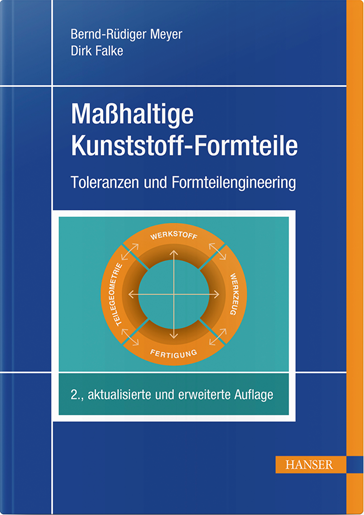
Our colleague Prof. Bernd-Rüdiger Meyer and co-author Dirk Falke have written a reference book on the dimensional accuracy of plastic moulded parts and on DIN 16742, published by Carl Hanser Verlag, Munich.
The most important decision fields of moulded part engineering are material, mould, production and part geometry. These fields and their interrelations are described with respect to the overriding quality criterion of dimensional accuracy. The focus is on material and mould; in addition, tolerance management and the influence of application and production conditions on dimensional accuracy are explained in detail. DIN 16742 is at the centre of the book. A central demand on part developers is the separation of functional tolerances (design tolerances) and production tolerances. Notes on the status of GPS standardisation are given, with particular emphasis on form and position tolerancing of plastic moulded parts. The authors' experience and practical examples support the reader.
Contents
- Principles for developing dimensionally accurate moulded parts
- Dimensional accuracy and geometrical product specification
- Introduction to tolerance management
- Dimensional reference levels for the application and production of moulded parts
- Plastic properties and their influence on the dimensional accuracy of moulded parts
- Influence of mould design on dimensional accuracy
- Applications of design and simulation techniques
- Production tolerancing according to DIN 16742
Another reference book by Prof. Meyer: The book to the software.
The software module "Commercial products" is optional and contains a database with the most important commercial product data of several plastics manufacturers – e.g. to refine the processing shrinkage. The database is also available as standalone software PolPlastics.
Moulding compounds of the following manufacturers are included
Included commercial products
The most important material data of the following moulding compounds are included:
| Commercial name | Manufacturer | Polymer family |
|---|
The trial version is limited in the nominal dimensions; full versions have no limitations. The commercial products database is optional.
| Trial version | Full version | Full version + commercial products DB | |
|---|---|---|---|
| free of charge | yes | no | no |
| registration required | no | yes | yes |
| direct tolerancing of nominal dimensions | size dimensions 5…55 mm | no limitations | no limitations |
| tolerances for profile deviations | nominal distances 50…120 mm | no limitations | no limitations |
| direct position tolerancing with cylindrical tolerance zones | nominal distances 5…30 mm | no limitations | no limitations |
| usable processing shrinkage values (approx. 500) | approx. 20% | all | all |
| usable commercial products (approx. 18,593) | approx. 5% | approx. 5% | all |
For system requirements see "Try it now" in the Description tab.